Hyperphaes
ὑπερφαής
brilliant-beyond-light: the Dionysian hyper-compound naming the divine luminosity that exceeds creaturely light
Take it homeOne Question, Three Traditions · seven classroom comparison chartsBuy
Across traditions
3 related terms, 0 across a tradition line, touching 1 of the four families.
this entry a related term (linked when it has a page) no page yet
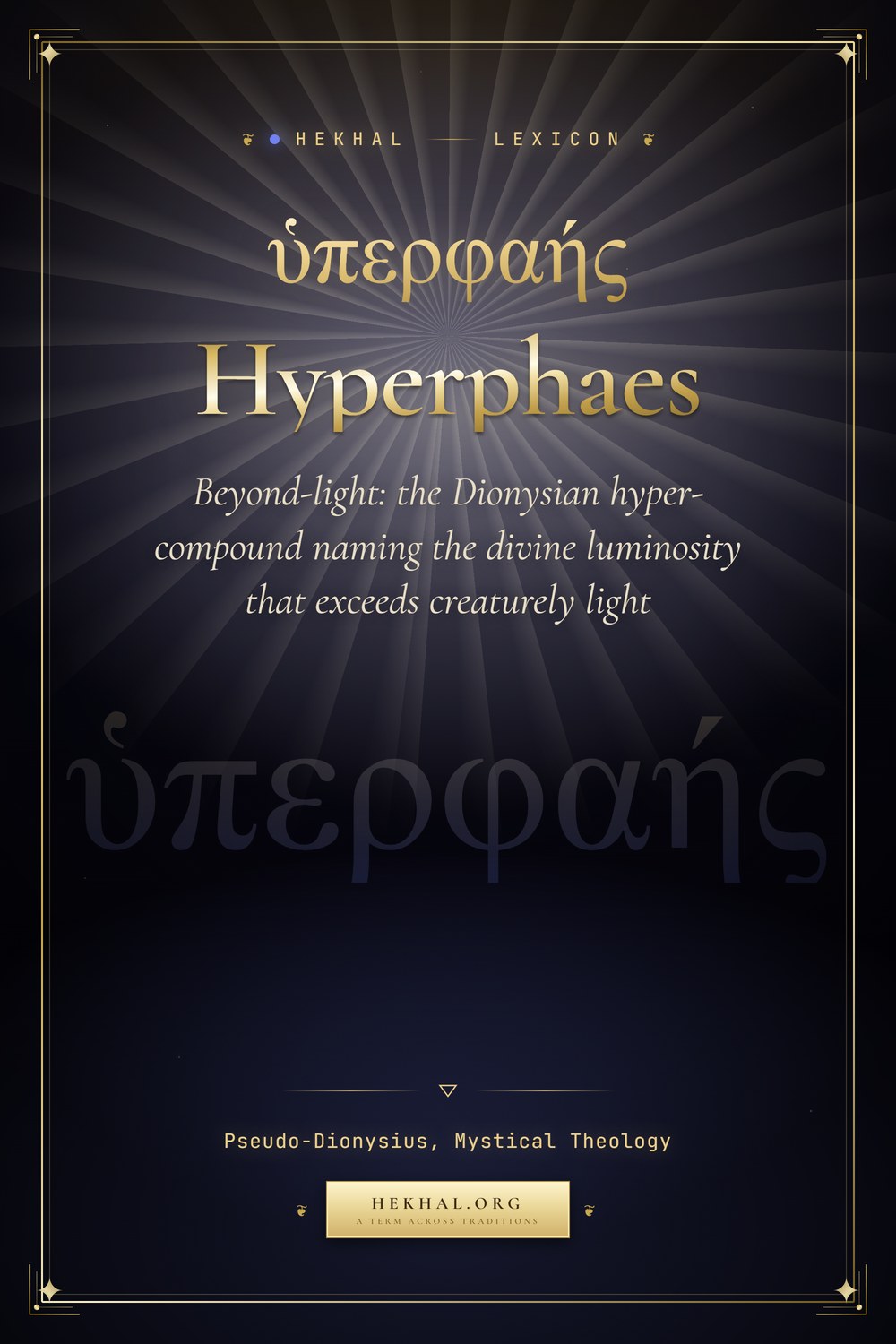
Hyperphaes (ὑπερφαής, “brilliant-beyond-light”) is the Dionysian hyper-compound naming the divine luminosity that exceeds creaturely light. The compound performs the characteristic Dionysian apophatic move: the divine is light, but with such excess that the light-predicate fails and must be qualified by the hyper- prefix. The contemplative encounters this excess-light as darkness (gnophos), and the Dionysian doctrine holds that the same divine register can be named under either modality: as light surpassing creaturely vision, the divine is hyperphaes; as that which the creature cannot bear to see, the divine is gnophos. The two predicates name the same reality from the divine and creaturely sides respectively.
The Targum engine’s controlled lexicon for pre-twelfth-century Greek source material forbids “bright,” “shining,” and “radiant” as glib renderings (which collapse the hyper-compound into a creaturely-degree light-predicate) and selects “brilliant-beyond-light” as the canonical hyphenated compound rendering, preserving the Dionysian hyper- register’s negation-by-excess.
Etymology
From Greek hyper- (above, beyond, in excess of) + phaēs / phaēos (light, brightness), giving the compound adjective “brilliant beyond.” The huper- prefix in Dionysian usage performs apophatic priority work; the compound hyperphaes belongs to the family of Dionysian apophatic compounds (alongside hyperousios, hyperagnostos, hyperagathos) that together constitute the huper- register.
Cross-tradition resonance
The Kabbalistic ohr ha-mistater (concealed light) and ohr ein sof (light of the Limitless) operate in a structurally parallel slot, naming a divine luminosity that exceeds and conceals itself in its own excess. The Akbarian discourse of nur (light) in Suhrawardian and Akbarian metaphysics, particularly Ghazali’s Mishkat al-Anwar, develops a comparable doctrine of divine light as that which screens itself through its own intensity.
Primary sources
- Pseudo-Dionysius, Mystical Theology: the locus classicus of the huper- register including hyperphaes.
- Pseudo-Dionysius, Divine Names IV: light as a divine name disciplined apophatically.
- Mishkat al-Anwar: Ghazali’s parallel light-ontology in Sufi register.
Scholarly literature
- Turner, The Darkness of God: the Dionysian darkness-and-light apophatic pair.
- Sells, Mystical Languages of Unsaying: comparative apophatic linguistics.
Read Hyperphaes where it lives
3 texts that use this word, free to keep
Texts on Hekhal that use this word in the translation and apparatus. Each is a typeset PDF to print and an ePub for an e-reader: original beside the English, full notes, citation line and licence.
- TextMystical Theology I.1; the opening prayerTranslated text · 8 ppPDFePub
- TextMystical Theology I.1; the opening prayerTranslated text · 9 ppPDFePub
- TextMystical TheologyTranslated text · 24 ppPDFePub
In the works of
Who uses Hyperphaes
On the influence maps
Where Hyperphaes sits in a cross-tradition comparison
- The Light-Ontology TrianglePlotinus, Pseudo-Dionysius, and the Mishkat al-Anwar
Points to 3
- christian mysticismHyperousios
The sister hyper-compound naming divine priority to being; hyperphaes performs the same logic on light.
- christian mysticismHyperagnostos
The hyper-compound for unknown-beyond-unknowing, completing the Dionysian apophatic register.
- christian mysticismGnophos
The divine darkness that hyperphaes is the luminous correlate of; the same divine register named under both registers.
Pointed to by 1
- christian mysticismHyperagnostos
The third member of the Dionysian apophatic hyper-triad, brilliant-beyond-light.
3 of these links cross into a different tradition. Each relation is stated in the entry's own data, and a structural parallel is named only where it holds.
Stable URLs are part of the editorial commitment. This address will not change.
Hekhal Editorial. "Hyperphaes." Hekhal: An Open Reference for Esoteric Tradition. Last modified June 30, 2026. https://hekhal.org/lexicon/hyperphaes.
Hekhal Editorial. 2026. "Hyperphaes." Hekhal: An Open Reference for Esoteric Tradition. https://hekhal.org/lexicon/hyperphaes.
Hekhal Editorial. "Hyperphaes." Hekhal: An Open Reference for Esoteric Tradition, Jun 30, 2026, hekhal.org/lexicon/hyperphaes.
Hekhal Editorial. (2026). Hyperphaes. Hekhal: An Open Reference for Esoteric Tradition. https://hekhal.org/lexicon/hyperphaes
@misc{hekhal-lexicon-hyperphaes-2026,
  author       = {{Hekhal Editorial}},
  title        = {{Hyperphaes}},
  year         = {2026},
  publisher    = {{Hekhal: An Open Reference for Esoteric Tradition}},
  url          = {https://hekhal.org/lexicon/hyperphaes},
  urldate      = {[date accessed]}
}