Take the library into the classroom, onto the wall, or keep it open
Everything Hekhal has published stays free to read, cite and teach. What is offered here is new work made on top of it: a ready-to-teach course pack, typeset printable editions, and the support that keeps the free layer free.
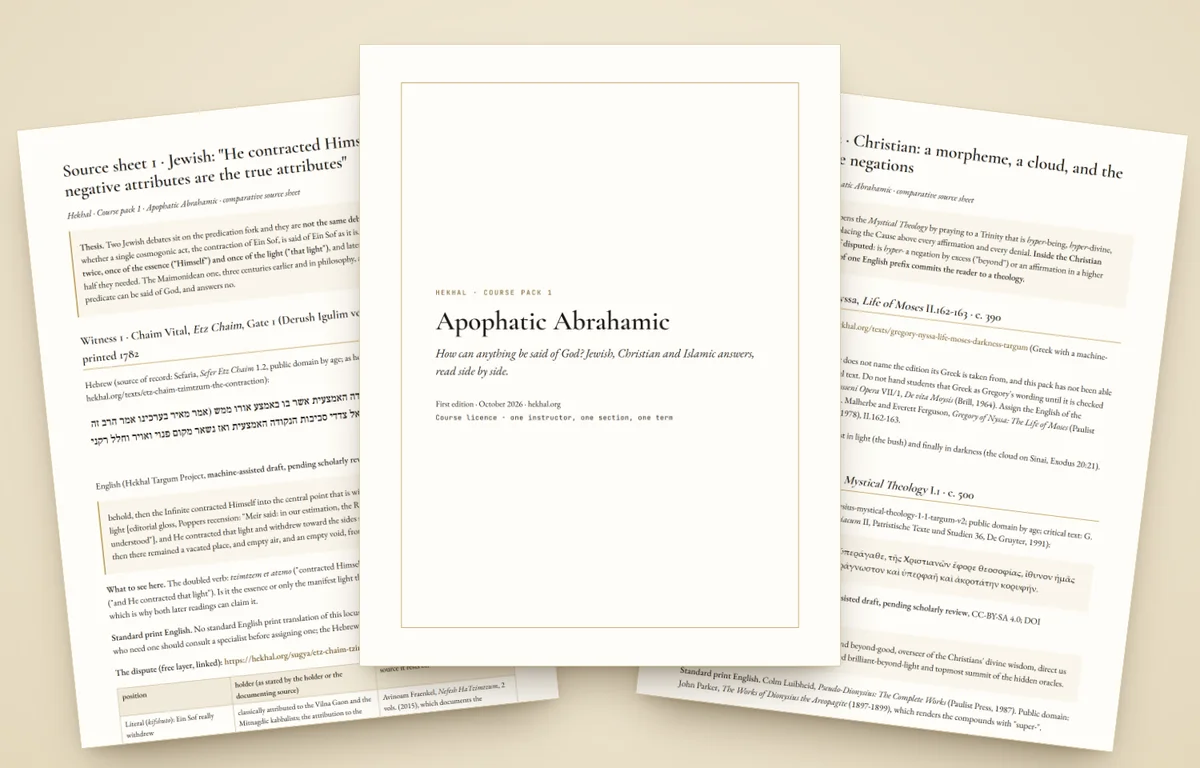
Apophatic Abrahamic: how can anything be said of God?
A drop-in teaching module of one session, one week or three weeks. One question, whether any positive predicate can be said of God, followed through three traditions in their own words: Vital and Maimonides, Dionysius the Areopagite, the kalam of the attributes and Ibn Arabi.
- A syllabus in three shapes, with full citations
- Four comparative source sheets: Hebrew, Greek and Arabic beside English, each link between traditions labelled as documented transmission or structural parallel
- Three assignments with rubrics, a discussion ladder, and instructor notes naming the standard translation to set beside each Hekhal draft
- 27 typeset pages, plus editable Word and Markdown files for your learning platform (course licence)
Hekhal's English renderings are machine-assisted drafts and are labelled as such; the original-language text is the text of record. A reviewed edition follows, and every buyer of this edition receives it free. Read the free sample week first.
One instructor, one section, one academic term. Host it in your course's LMS, print it, adapt it.
Buy · $300The same pack for one reader's own study. Not for classroom distribution.
Buy · $29Department or multi-section licence, an invoice for your institution, or a pack built around your own syllabus: see For Institutions or write to [email protected].
One Question, Three Traditions
Seven one-page charts that set Jewish, Christian and Islamic mysticism side by side on a single question, each with a student worksheet and an answer key. Every line between two traditions is marked T, documented transmission, or S, a parallel with no documented contact, so students learn to tell influence from resemblance. Each chart prints its key terms and one short quotation in Hebrew, Greek or Arabic, with an exact reference.
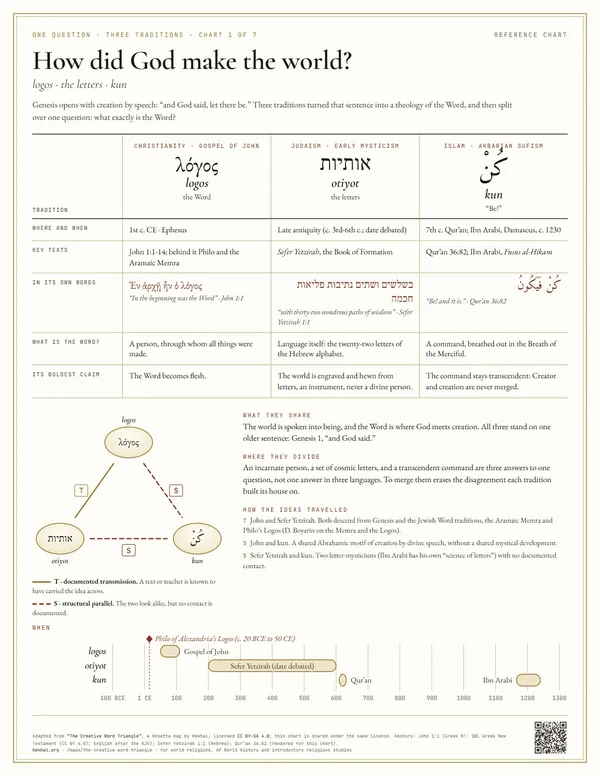 01How did God make the world?
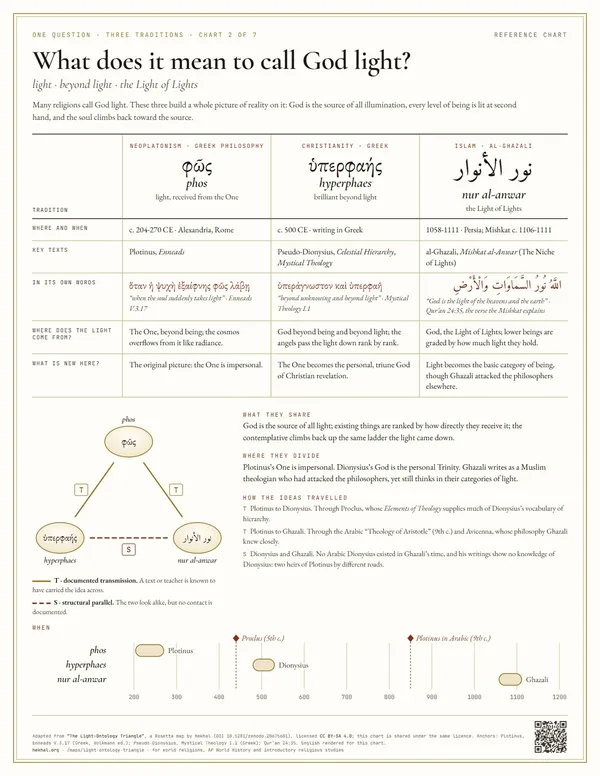 02What does it mean to call God light?
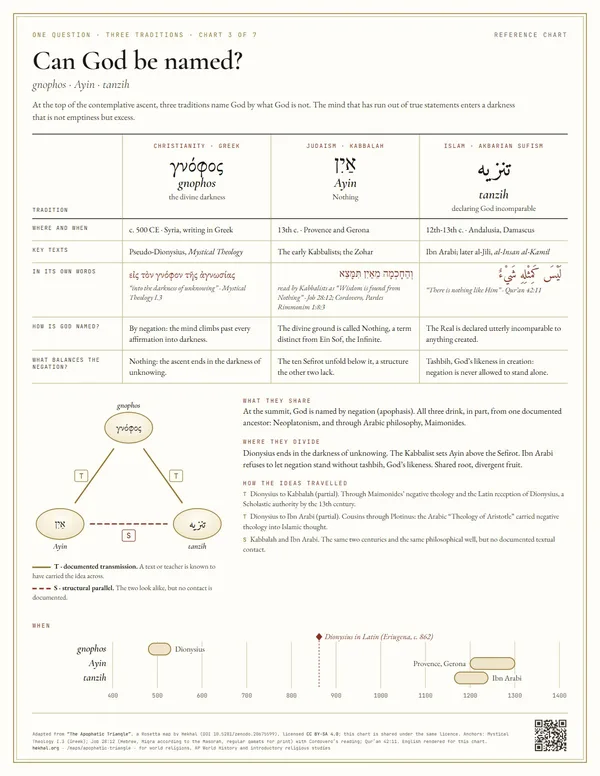 03Can God be named?
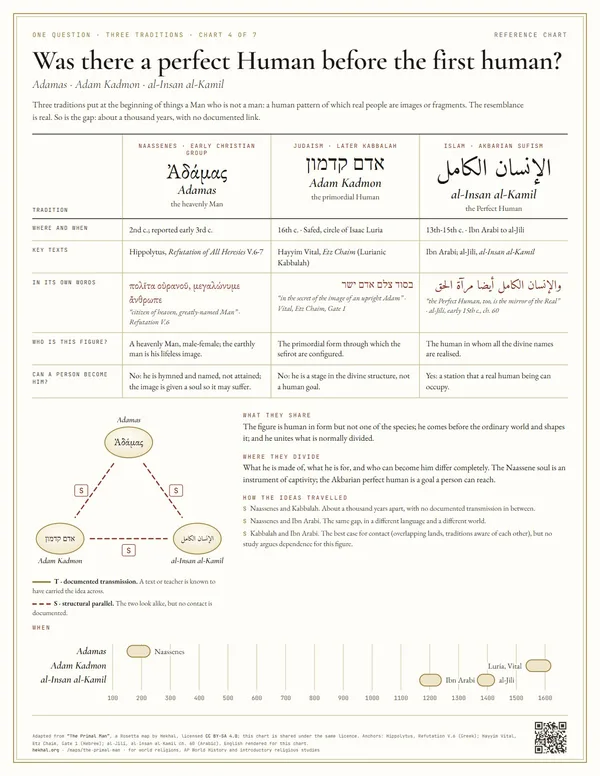 04Was there a perfect Human before the first human?
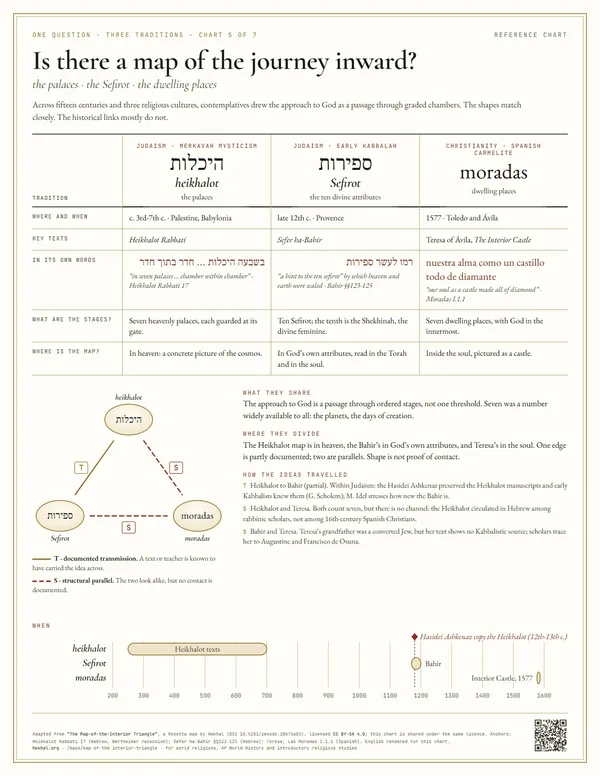 05Is there a map of the journey inward?
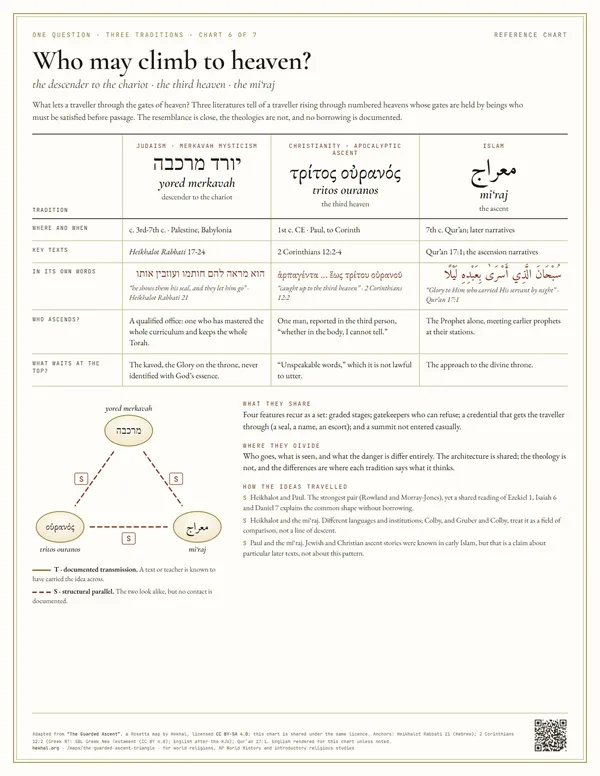 06Who may climb to heaven?
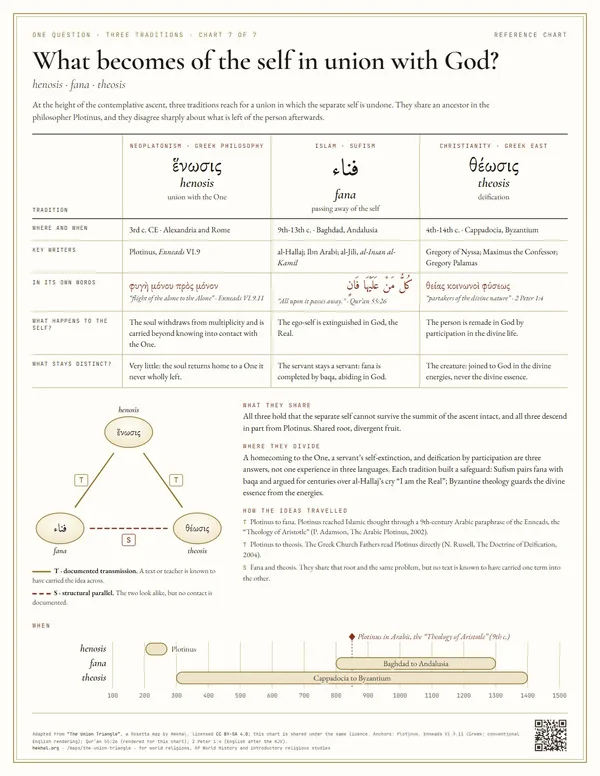 07What becomes of the self in union with God?
Try one first: download chart 7, “What becomes of the self in union with God?”, free (reference chart, worksheet and answer key). The charts adapt Hekhal’s Rosetta maps, released under CC BY-SA 4.0, and are shared under the same licence.
Printable editions
Diagrams and term cards typeset from the Hekhal editions, with every source named on the print. Each is a PDF in several sizes, to print at home or at any print shop. Nothing is shipped.
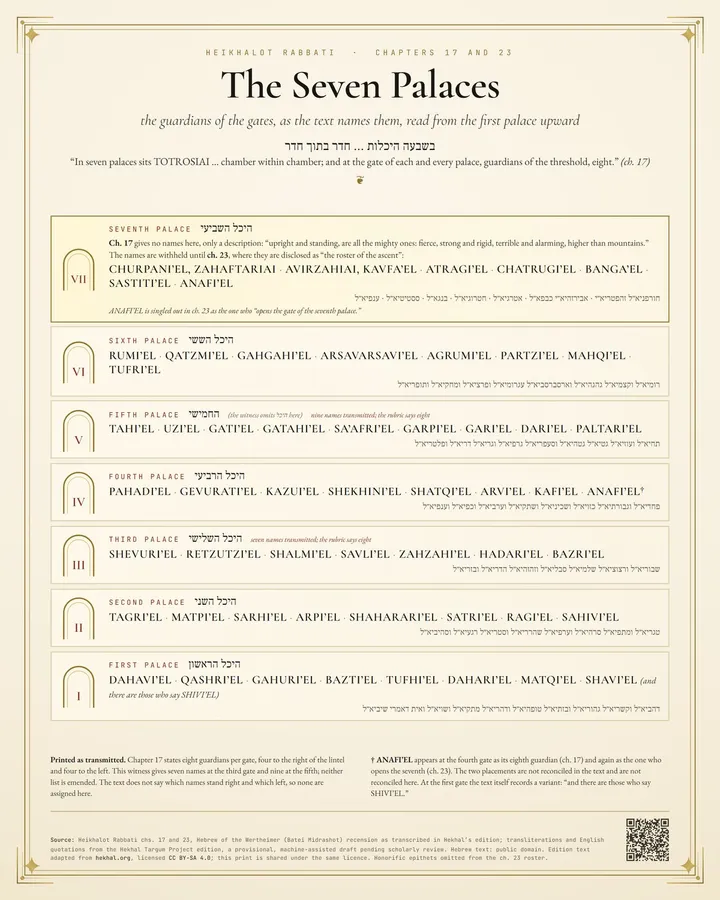
The Seven Palaces · Heikhalot Rabbati 17 and 23
The guardians at each gate as chapter 17 names them, the seventh gate as chapter 23 discloses it, the text's irregularities printed rather than tidied. Hebrew with transliteration.
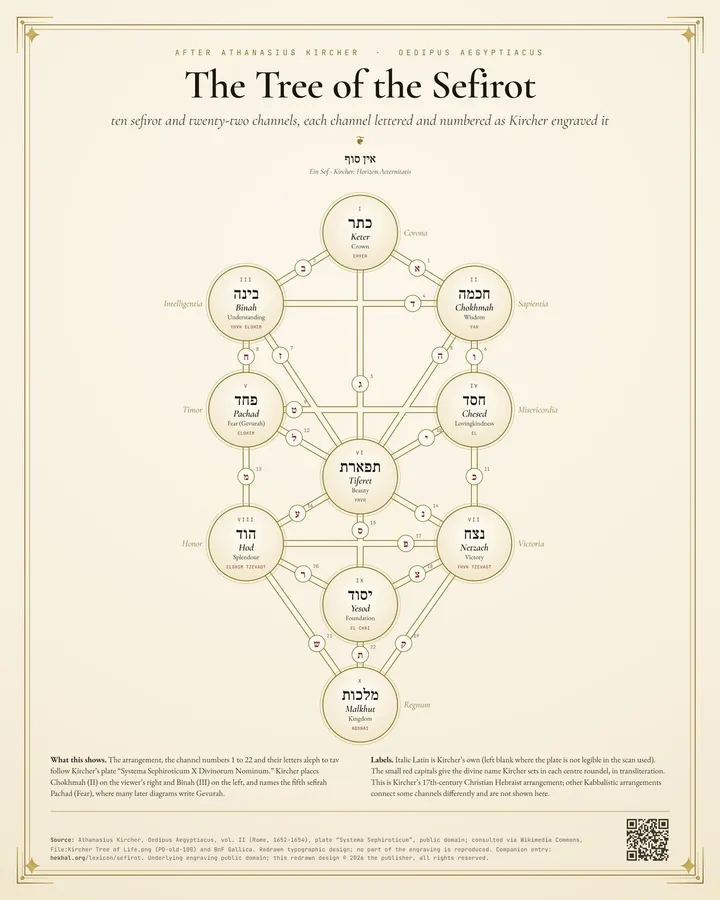
The Tree of the Sefirot, after Kircher
Athanasius Kircher's Sefirotic tree redrawn: ten sefirot with Hebrew, transliteration and meaning, twenty-two channels with his letters and numbers, his Latin labels. Source plate named on the print.
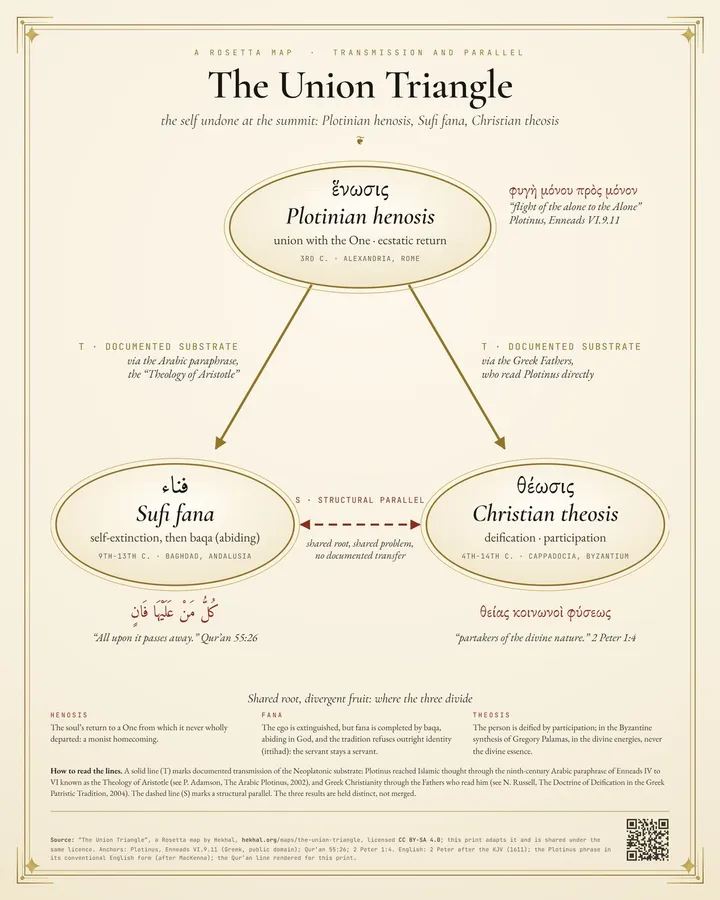
The Union Triangle · henosis, fana, theosis
Three traditions that speak of the self undone in union: Plotinian henosis, Sufi fana, Christian theosis, each in its own terms. Adapted from the Hekhal Rosetta map (CC BY-SA 4.0).
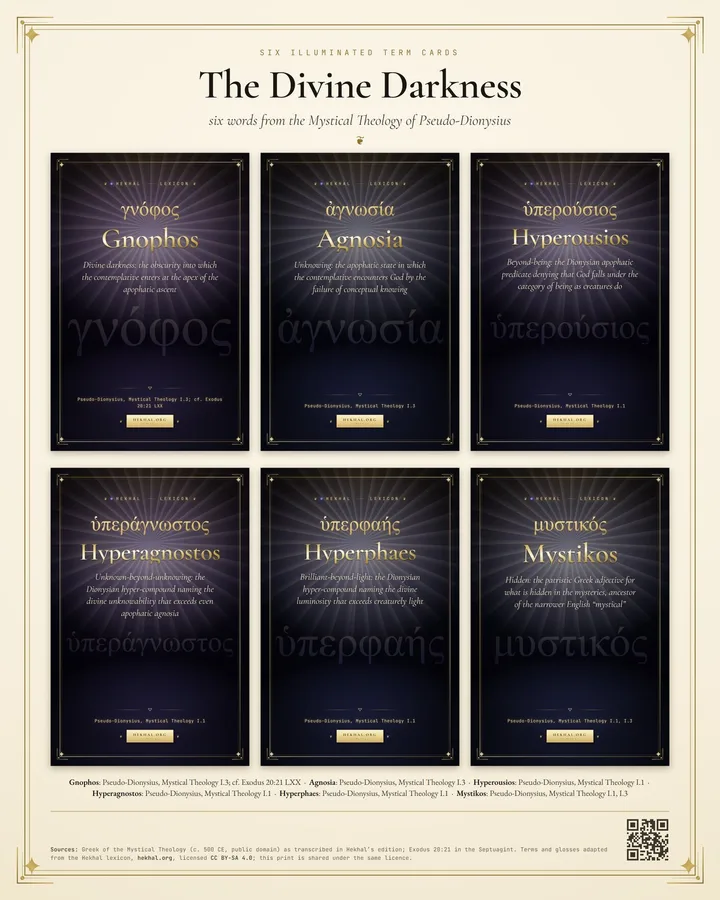
The Divine Darkness · six term cards from the Mystical Theology
Gnophos, agnosia, hyperousios, hyperagnostos, hyperphaes, mystikos: six illuminated cards in Greek with their loci in Dionysius, plus two grid sheets.
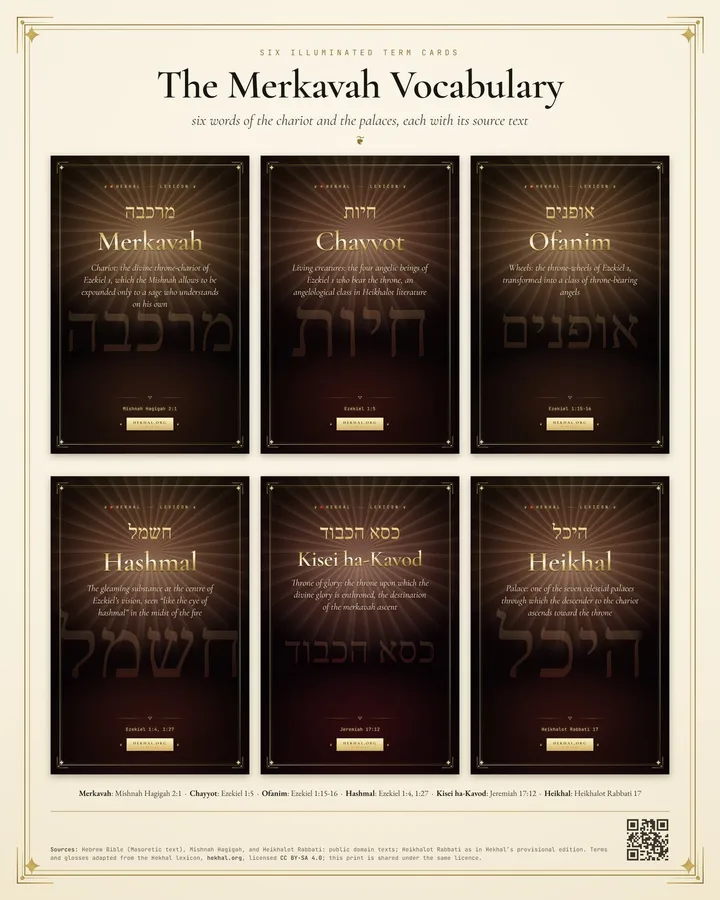
The Merkavah Vocabulary · six Hebrew term cards
Merkavah, chayyot, ofanim, hashmal, kisei ha-kavod, heikhal: six illuminated cards with the Hebrew of each locus, from Ezekiel to the Heikhalot.
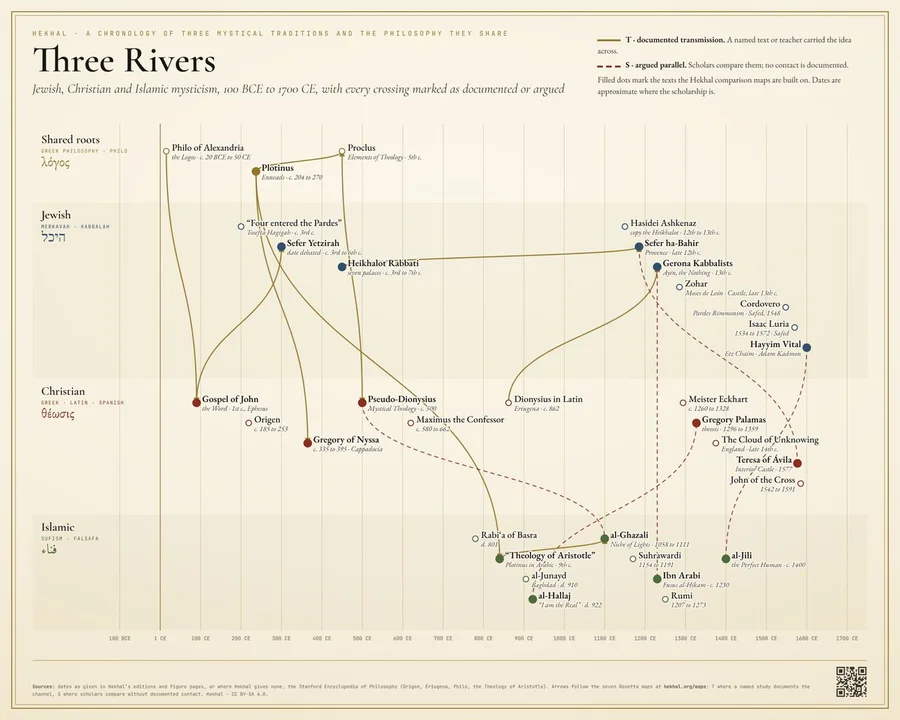
Three Rivers · a timeline of Jewish, Christian and Islamic mysticism
Thirty-three figures and texts from Philo to Hayyim Vital on one axis, 100 BCE to 1700 CE, with every crossing between traditions drawn as documented transmission or argued parallel.
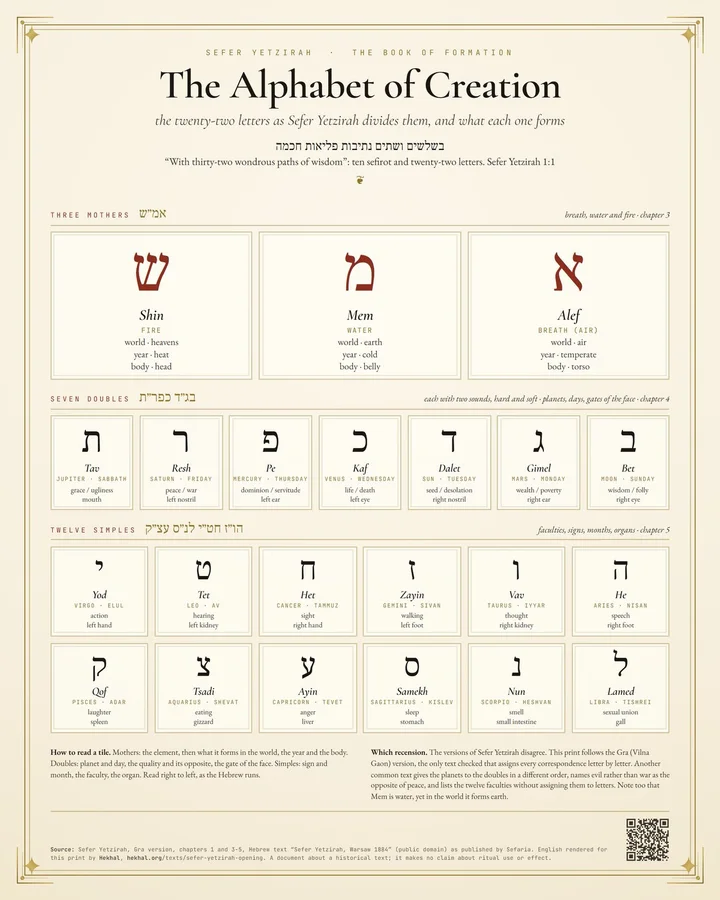
The Alphabet of Creation · the 22 letters of Sefer Yetzirah
The three mothers, seven doubles and twelve simples with every correspondence the Gra recension gives: element, planet, day, quality, sign, month, faculty and organ. The recension is named on the print.
Each print names its sources in its credits. Where the English follows the Hekhal Targum drafts, which are machine-assisted and pending scholarly review, the print says so. These are documents about historical texts and make no claim about ritual use or effect.
Reading the Abrahamic mystics side by side
Four live online sessions of 75 minutes with the editor, weekly from the week of January 11, 2027, capped at 25. Founding seats are $149 (the course will be $199). The course runs only if at least 8 seats are taken; if not, every founding seat is refunded in full. Every seat includes the department edition of the classroom charts, and three seats are free for readers who could not otherwise attend.
- The Merkavah ascent. The Heikhalot palaces and their gatekeepers, beside Paul’s third heaven and the mi‘raj.
- Dionysius and the way of unsaying. The divine darkness, the Kabbalists’ Ayin, and Ibn Arabi’s tanzih: can God be named?
- Ibn Arabi and al-Jili on the Perfect Human. al-Insan al-Kamil beside Adam Kadmon and the Naassene Adamas.
- The question the traditions still dispute. Henosis, fana and theosis, and whether the mystics describe the same experience, argued from the evidence.
Each session reads the key passage in Hebrew, Greek or Arabic beside Hekhal’s English, argues a real scholarly dispute from both sides, and ends with the class judging each link between traditions as documented transmission or parallel. No languages are needed. As a capstone, each participant builds a three-tradition map of their own; with permission, the best are published on Hekhal with credit. Educators also leave with a classroom version of each session.
Three seats are free for readers who could not otherwise attend: write to the editor.
Support the library
Hekhal is maintained by one named editor and carries no display advertising and takes no sponsorship. Contributions pay for model costs, source plates and reviewer honoraria, and keep every text, map and dataset free.
Five dollars a month. Cancel any time from the link in your receipt.
Give monthlyHow it works
- Delivery
- Payment is handled by Stripe. Your download links appear as soon as payment clears and are emailed to you; they work for 14 days, and a fresh link is one reply away.
- What stays open
- Material Hekhal has already released under CC-BY-SA 4.0 stays under that licence inside anything sold here. You are paying for the new work, the assembly and the support, never for access to the free layer.
- Problems
- If a file is faulty or not what the page describes, reply to your order email and it will be fixed or refunded.