A library and an apparatus your program can use freely.
Hekhal publishes rigorously sourced primary texts of the mystical, contemplative, and philosophical traditions, in the original beside English, with the full scholarly apparatus exposed. All of it is openly licensed and free to read, assign, and cite. If you teach or research in these areas, it is built for you.
Most digital resources for these traditions are one of three things: encyclopedically shallow, locked behind a publisher's paywall, or unreliable. Small and growing programs, in particular, rarely have affordable, trustworthy, openly-licensed infrastructure for teaching Kabbalah and Jewish mysticism, Akbarian and formative Sufism, Christian apophatic and hesychast theology, Hermetism, Neoplatonism, and the traditions around them. Hekhal exists to close that gap, in the open.
Everything below is available now, at no cost, under a Creative Commons license, and it will stay that way. The library is free to read, assign, and cite, with no account. For programs that want more than the library, a small set of paid course materials and services is described further down. Buying them is never required to use anything here, and the invitation stands: use it, and, if you are willing, make it better.
What your program can use, freely
In the classroom
Assign a Hekhal edition and your students read the primary source and a transparent translation side by side, with every interpretive choice visible and every term linked to its sourced definition. The reading paths give you a sequenced route through a tradition to use as a syllabus spine or to adapt. Machine-assisted drafts are labeled as provisional, so a class always knows exactly how much trust a given passage has earned.
If you send us a reading list, we will build it into Hekhal as a course space, with editions and apparatus in place, at no cost. Tell us the tradition and the texts and we will do the work.
In research
The corpus and its datasets are openly licensed and citable, with minted DOIs, per-page scholarly citation metadata, and machine-readable exports. The disagreement topology maps where the same conceptual fault-line recurs across the Abrahamic traditions, sourced and provisional, an instrument rather than an assertion. Every position traces to a real, locatable document; cross-tradition parallels are reported only where a named scholar drew them, with a citation. Corrections are genuinely welcome and are recorded.
See it, ready to teach
Concrete artifacts you can open, assign, or adapt today, each free and openly licensed.
The terms, stated plainly
- Free and openly licensed, permanently. Corpus content and datasets published here are CC-BY-SA and stay so. Read, reproduce, adapt, and redistribute with attribution. No paywall, no account required to read.
- Paid materials are separate and new. Course packs, continuing-education modules, and commissioned work are newly made for the programs that pay for them. They never wall off anything in the open library, and the source texts they draw on keep their own licenses.
- Honest about status. Every translation carries its provenance and a status (verified, public-domain, machine-assisted, community, commissioned). Nothing machine-drafted ships as verified without a human editor's sign-off.
- Nothing fabricated. Every primary-text claim traces to real source material. No invented sources, no invented reviewers, no parallels asserted in our own voice.
- No authority claimed. Hekhal is a reference and a set of instruments, not a religious authority. It preserves disagreement rather than resolving it.
For programs that want it ready-made
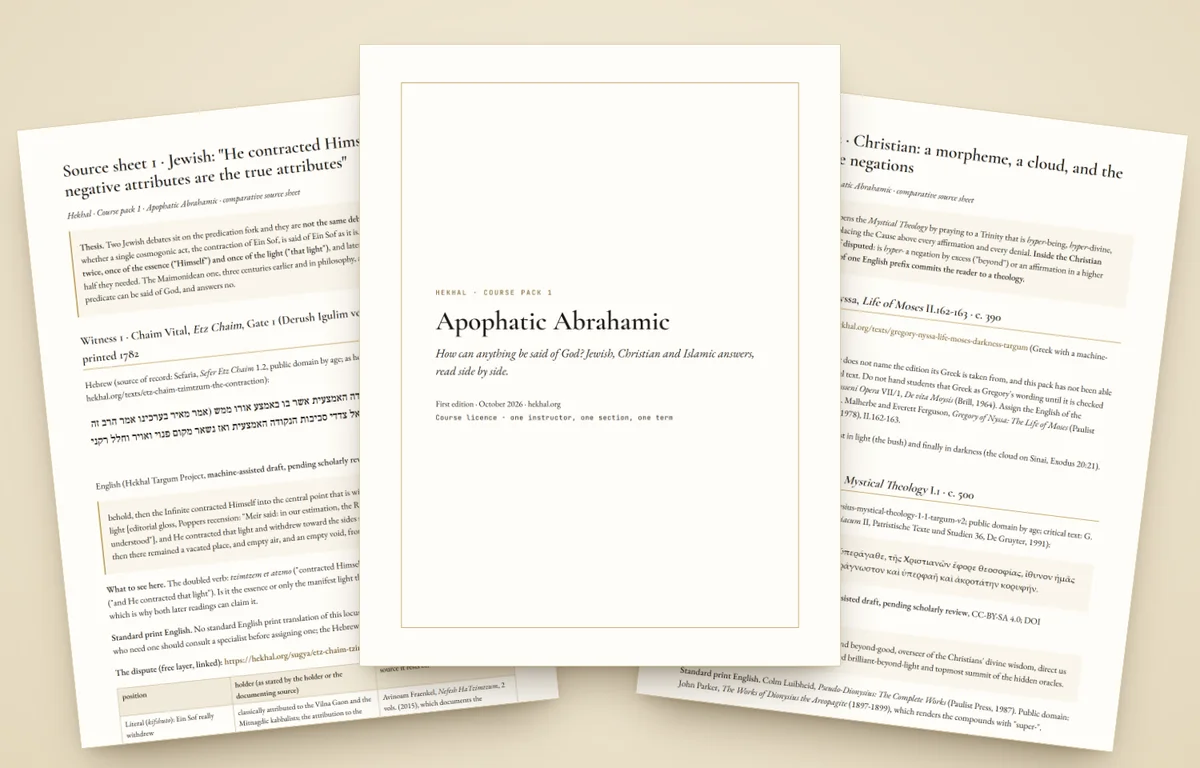
Course Pack 1 · Apophatic Abrahamic
How can anything be said of God? A drop-in module of one session to three weeks: syllabus, four comparative source sheets in Hebrew, Greek and Arabic beside English, three assignments with rubrics, discussion ladder, instructor notes. 27 typeset pages plus editable files for your LMS. The reviewed edition is sent free.
- Course packs. A ready-to-teach module built around one question the traditions dispute: a syllabus, comparative source sheets, assignments with rubrics, discussion questions, and instructor notes, exported for your learning platform. Licensed per course, per semester. Course Pack 1, Apophatic Abrahamic is available now at $300 per course per semester, with a free sample week. Or send your reading list and we build your first week free.
- Continuing education for chaplains (in preparation). A self-paced course in Abrahamic interfaith literacy for hospital, hospice, military, and prison chaplains, with a certificate of hours for your own annual continuing-education report.
- Commissioned editions. A passage set your program needs, translated with the full apparatus and reviewed by a named specialist. Your program is credited, and the edition is published openly.
- Verification of machine translations. If your program or press is translating classical texts with a language model, Targum Verify produces the checkable trail an editor needs. The first diagnostic is free.
- Grant-funded projects. If your faculty hold or are planning a teaching grant, we can serve as the outside resource and supply the materials.
Ask for terms: write to vinnycouey@gmail.com. We reply with a price that fits your program's size and budget.
Adopt it, partner with us, or correct us
Institutional partnership, a corpus your students need that we do not yet host, or a question: write to vinnycouey@gmail.com. Hekhal is maintained by a named editor and gives before it asks.
Want it built for you? Beyond the free reading-list setup, Hekhal takes paid commissions: a custom unit or syllabus built on your curriculum, department and district licences for the classroom charts, and professional development on the transmission-or-parallel method. Purchase orders and invoices are fine. Ask for a quote.