Teach the mystics side by side, with the evidence on the page.
Every resource here puts Jewish, Christian and Islamic texts on the same question and asks students to judge each link between traditions: T, where a named text or teacher carried the idea across, or S, where the ideas look alike but no contact is documented. It is the skill of telling influence from resemblance, practised on primary sources. Everything below that says free is free, and stays free.
For one lesson A single class period
Free · PDF · chart, student worksheet and answer key
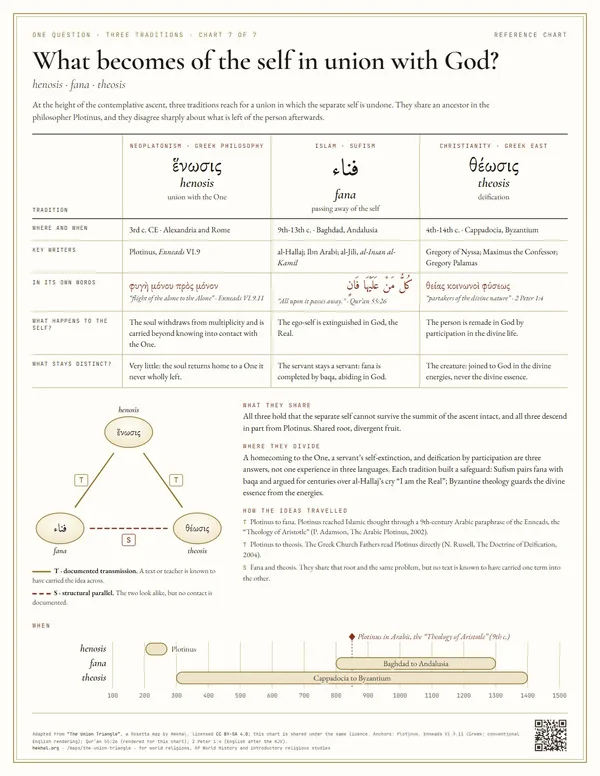
What becomes of the self in union with God?
Plotinian henosis, Sufi fana and Christian theosis on one page, each with its original word and one sourced quotation, then a worksheet where students label every link T or S. Question 4 works as an exit ticket. The map behind it.
Each of the seven cross-tradition maps works as a lesson on its own, free to project or assign:
-
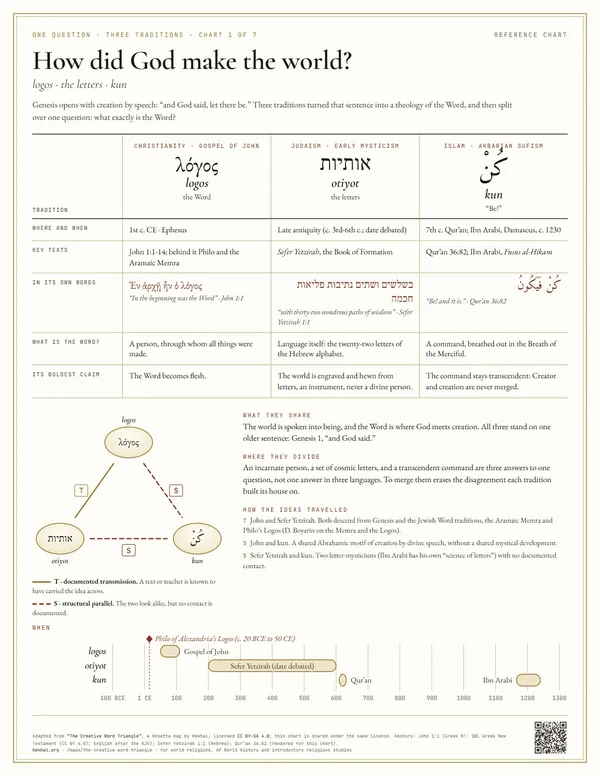 How did God make the world? The Creative Word Triangle
-
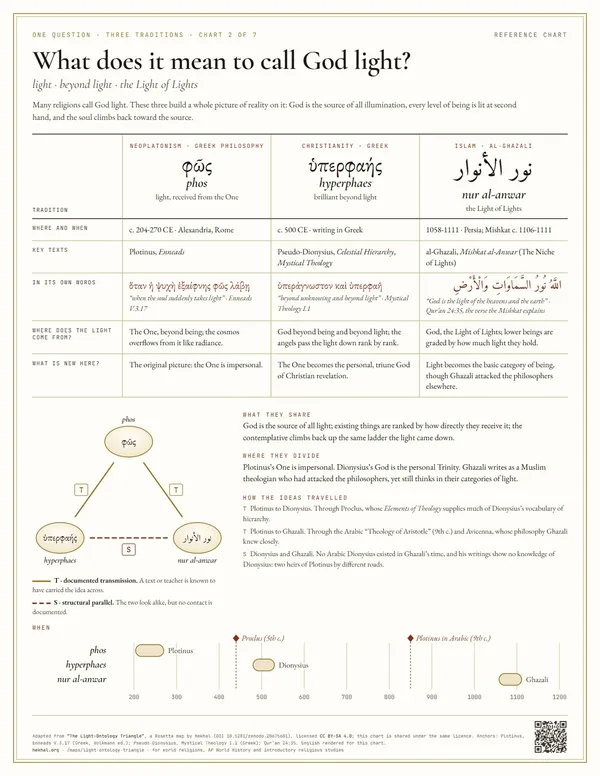 What does it mean to call God light? The Light-Ontology Triangle
-
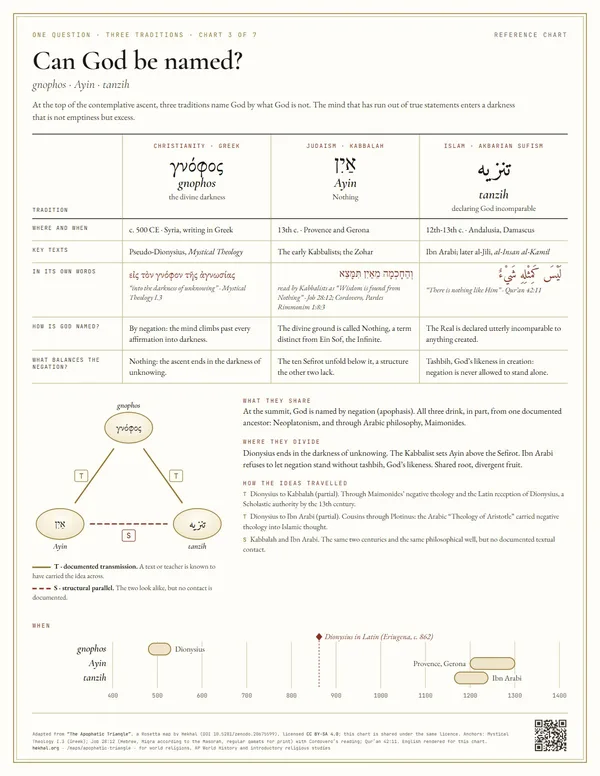 Can God be named? The Apophatic Triangle
-
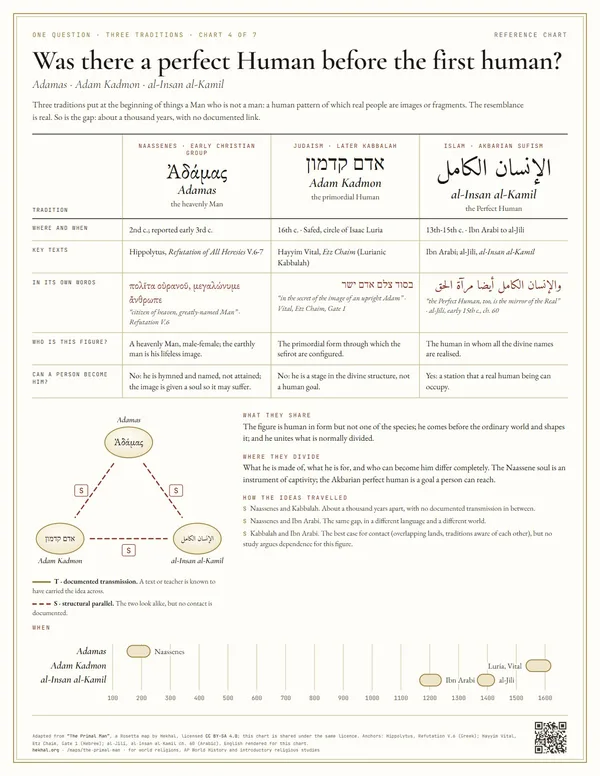 Was there a perfect Human before the first human? The Primal Man
-
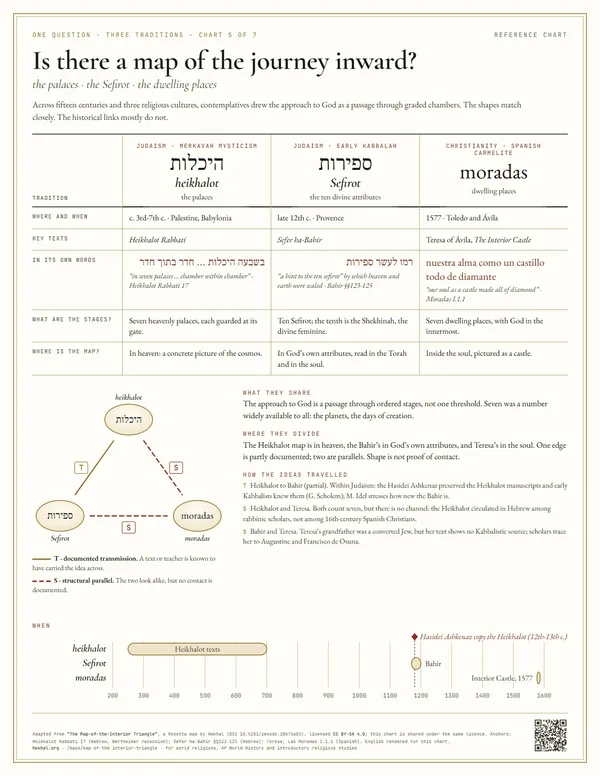 Is there a map of the journey inward? The Map-of-the-Interior Triangle
-
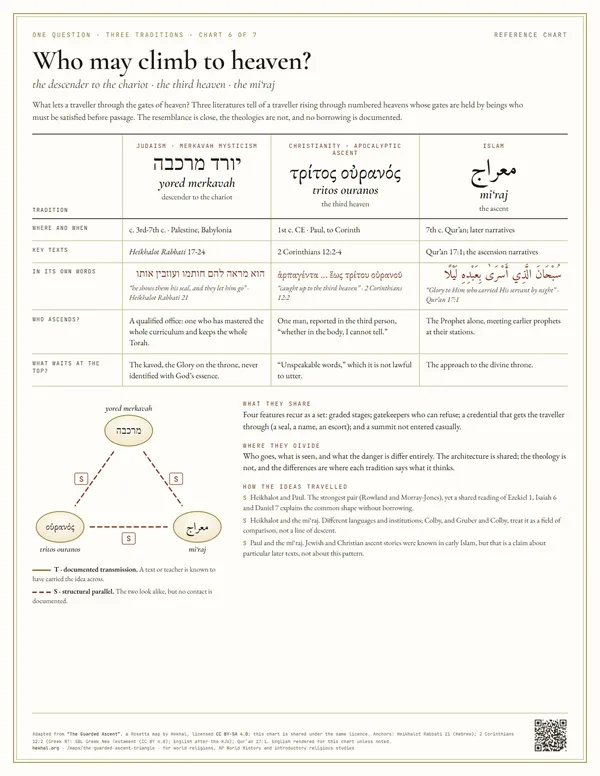 Who may climb to heaven? The Guarded Ascent
- What becomes of the self in union with God? The Union Triangle
For a unit Two to four weeks
One Question, Three Traditions: all seven charts
Every chart above as a reference page, a student worksheet and an answer key, with a teacher guide (three ways to run the set) and a 21-term glossary. 23 pages, US Letter and A4.
Free reading paths sequence the primary texts for a unit, each with a printable syllabus:
- Predication and the Divine: How Can Anything Be Said of God? · One fork, three traditions, each in its own terms. Tzimtzum and Maimonidean negation, Nyssa and Dionysius, the kalam of the attributes and Ibn Arabi on tanzih and tashbih. · syllabus
- The Apophatic Tradition · From Plotinus through Pseudo-Dionysius into the Western Christian apophatic line, with the Akbarian Sufi parallel · syllabus
- The Divine Names · From Plotinus and Pseudo-Dionysius through the Kabbalistic Sefirot into Akbarian Sufi divine-name speculation · syllabus
- The Palace Ascent · From Heikhalot literature through the Bahir into Teresa's Interior Castle · syllabus
For a course A semester module
Course Pack 1 · Apophatic Abrahamic
A ready-to-teach module on whether anything can be said of God, across Judaism, Christianity and Islam: a syllabus, four source sheets in Hebrew, Greek and Arabic beside English, a discussion ladder and instructor notes. 27 pages; the course licence adds editable Word and Markdown files for your learning platform.
The whole library is open for assigning and citing: bilingual primary texts, the sourced lexicon for vocabulary, and the debate maps for seminar arguments. How programs use Hekhal.
For a department Every teacher in the building
Department edition
The seven charts for every teacher in one school, plus an editable Word worksheet and answer key for each chart (change the questions, the word bank or the reading level) and a projection deck per chart: the chart, each tradition in its own words, a "T or S?" slide for the class to argue, the evidence, and discussion.
District or network licence
The department edition for every school in a district, diocese or network, with a live 60-minute online session for your teachers on the transmission-or-parallel method, at a time that suits you.
Need it built around your curriculum? Hekhal takes commissions for a custom unit or syllabus and for longer professional development. Ask for a quote. The materials adapt Hekhal's openly licensed maps and stay under CC BY-SA 4.0; what these editions add is the editable files, the slides and the session.