Gnophos
γνόφος
divine darkness: the obscurity into which the contemplative enters at the apex of the apophatic ascent
Take it homeThe Divine Darkness · six term cards from the Mystical TheologyBuy
Across traditions
3 related terms, 2 across a tradition line, touching 3 of the four families.
this entry a related term (linked when it has a page) no page yet
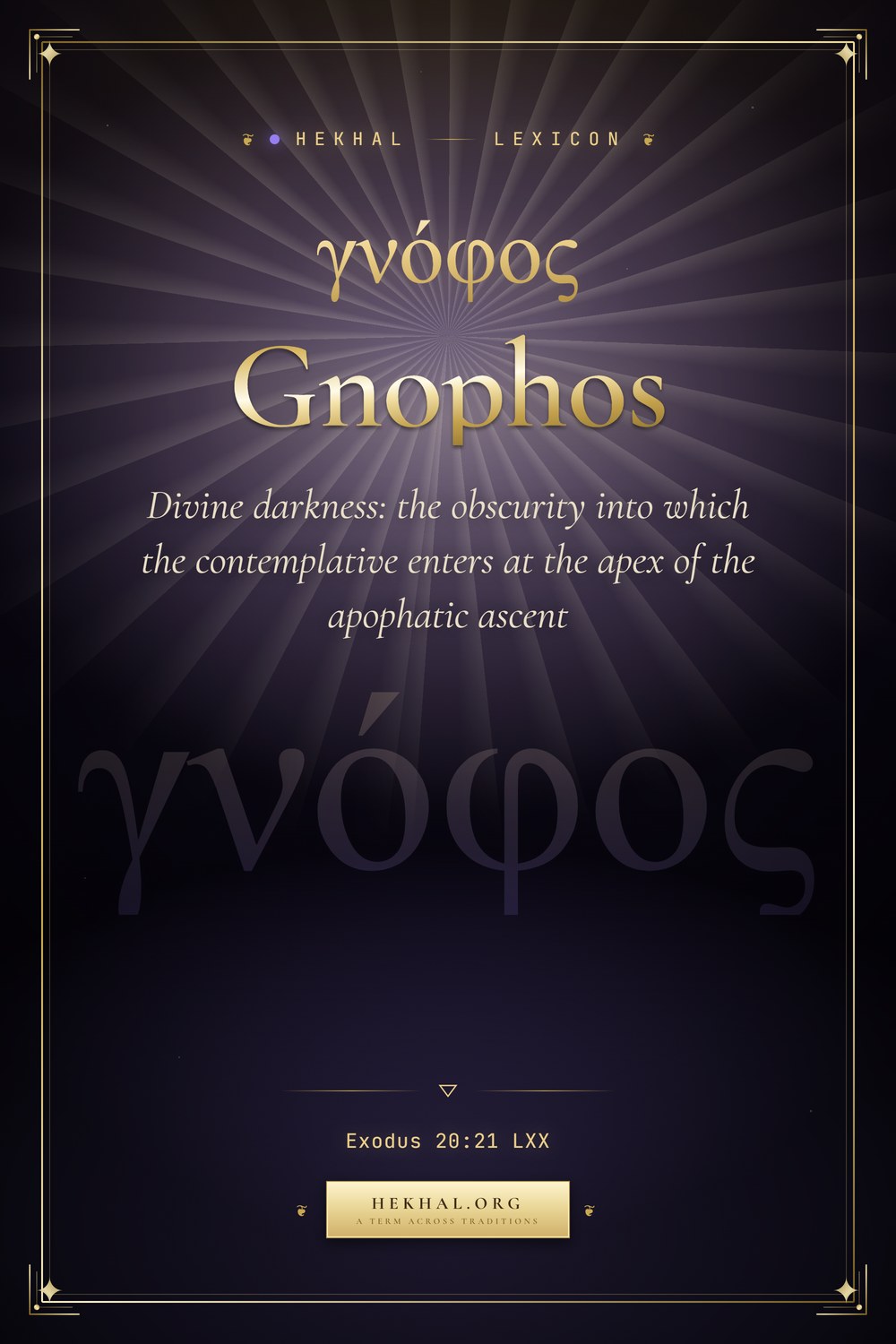
Gnophos (γνόφος, “thick darkness,” “gloom”) is the Dionysian term for the divine darkness into which Moses enters at the summit of Sinai (Exodus 20:21 LXX, “And Moses drew near unto the gnophos where God was”). Pseudo-Dionysius takes the Sinai narrative as the controlling typology for the apophatic ascent: the contemplative ascends through the kataphatic foothills, the apophatic slope, and the cloud of unknowing into a darkness that is the proper medium of encounter with the divine. The gnophos is not absence of God; it is God’s presence as it appears to a creature incapable of bearing direct sight. The technical doctrine is therefore that the divine darkness is a darkness of luminous excess, not of privation: the divine exceeds the creature’s capacity to see and registers as darkness for that reason.
Gregory of Nyssa’s Life of Moses makes the same Sinai typology load-bearing for the spiritual ascent and is the most influential pre-Dionysian patristic source on the divine darkness. The doctrine then passes through Dionysius into the Cloud of Unknowing tradition (where the cloud is the gnophos rendered in Middle English) and into the Carmelite noche oscura (John of the Cross’s “dark night”), where gnophos acquires a more pronounced experiential-purgative coloration.
Etymology
From Greek gnophos, “thick darkness,” “gloom,” with overlapping field with skotos (darkness, often moral) and zophos (gloom, often Hadean). The Septuagint translators’ choice of gnophos for the Sinai narrative fixes the term’s theological-mystical register and is the controlling textual precedent for the patristic and Dionysian tradition.
Cross-tradition resonance
The Kabbalistic Concealed Light (ohr ha-mistater) names a structurally adjacent phenomenon, divine illumination so excessive that it registers as darkness. The Sufi hijab (veil) performs comparable screening, though through the perceiver’s limitation rather than through divine excess. The Vedantic neti neti tradition operates apophatically at the cognitive register without an analogous luminous-darkness imagery.
Primary sources
- Exodus 20:21 LXX: the Sinai gnophos that fixes the term.
- Gregory of Nyssa, Life of Moses: the patristic locus classicus.
- Pseudo-Dionysius, Mystical Theology 1: the Dionysian doctrine.
- John of the Cross, Noche Oscura: the Carmelite reception.
Scholarly literature
- Louth, The Origins of the Christian Mystical Tradition: gnophos in patristic and Dionysian context.
- McGinn, The Foundations of Mysticism: the divine-darkness tradition through the medieval West.
Read Gnophos where it lives
7 texts that use this word, free to keep
Texts on Hekhal that use this word in the translation and apparatus. Each is a typeset PDF to print and an ePub for an e-reader: original beside the English, full notes, citation line and licence.
- TextMystical Theology I.3; the truly mystical darkness of unknowingTranslated text · 8 ppPDFePub
- TextLife of Moses II §162-163; the entry into the darknessTranslated text · 11 ppPDFePub
- TextMystical TheologyTranslated text · 24 ppPDFePub
- TextMystical Theology I.1; the opening prayerTranslated text · 9 ppPDFePub
3 more texts use this word. Every translated text has one: the full list.
In the works of
Who uses Gnophos
On the influence maps
Where Gnophos sits in a cross-tradition comparison
- The Apophatic TriangleThe God beyond knowing in Dionysian gnophos, Kabbalistic Ayin, and Akbarian tanzih
Points to 3
- christian mysticismAgnosia
The cognitive state in which the contemplative meets the divine darkness; gnophos is the medium, agnosia is the cognitive condition.
- cross traditionApophasis
The method whose end-state gnophos names.
- islamic mysticismHijab
The Sufi veiling that performs analogous screening, though through the perceiver's limitation rather than through luminous excess.
Pointed to by 3
- christian mysticismAgnosia
The divine darkness in which agnosia takes place; gnophos is the medium, agnosia is the cognitive condition.
- islamic mysticismHijab
The Dionysian divine darkness that performs analogous screening through luminous excess rather than concealment proper.
- christian mysticismHyperphaes
The divine darkness that hyperphaes is the luminous correlate of; the same divine register named under both registers.
2 of these links cross into a different tradition. Each relation is stated in the entry's own data, and a structural parallel is named only where it holds.
Stable URLs are part of the editorial commitment. This address will not change.
Hekhal Editorial. "Gnophos." Hekhal: An Open Reference for Esoteric Tradition. Last modified June 30, 2026. https://hekhal.org/lexicon/gnophos.
Hekhal Editorial. 2026. "Gnophos." Hekhal: An Open Reference for Esoteric Tradition. https://hekhal.org/lexicon/gnophos.
Hekhal Editorial. "Gnophos." Hekhal: An Open Reference for Esoteric Tradition, Jun 30, 2026, hekhal.org/lexicon/gnophos.
Hekhal Editorial. (2026). Gnophos. Hekhal: An Open Reference for Esoteric Tradition. https://hekhal.org/lexicon/gnophos
@misc{hekhal-lexicon-gnophos-2026,
  author       = {{Hekhal Editorial}},
  title        = {{Gnophos}},
  year         = {2026},
  publisher    = {{Hekhal: An Open Reference for Esoteric Tradition}},
  url          = {https://hekhal.org/lexicon/gnophos},
  urldate      = {[date accessed]}
}