The Zohar read as a library rather than a book -- authorship, the Pritzker critical-Aramaic edition, sefirot and partzufim and Shekhinah, the Idrot, Tikkunei Zohar and Ra'aya Mehemna, and the reception that runs through Cordovero, Luria, Sabbateanism, Hasidism, and the modern academy.
The Zohar and the Pritzker Edition
The Zohar is the central canonical text of Kabbalah. It is also not, in the strict philological sense, a single text. The Zohar is a library that fourteenth-century manuscript transmission and sixteenth-century printers gathered under one name, whose individual works were composed across at least two generations in late-thirteenth-century Castile, and whose textual surface remained editorially insecure until Daniel Matt’s critical Aramaic edition appeared between 2003 and 2017. The high-level orientation to the corpus lives at the Kabbalah codex; the present sub-codex picks up at the level of the Zoharic library’s internal organization, the authorship question, the Pritzker edition and what it changed, and the reception history that carries Zoharic Kabbalah from late-medieval Castile to the contemporary academy.
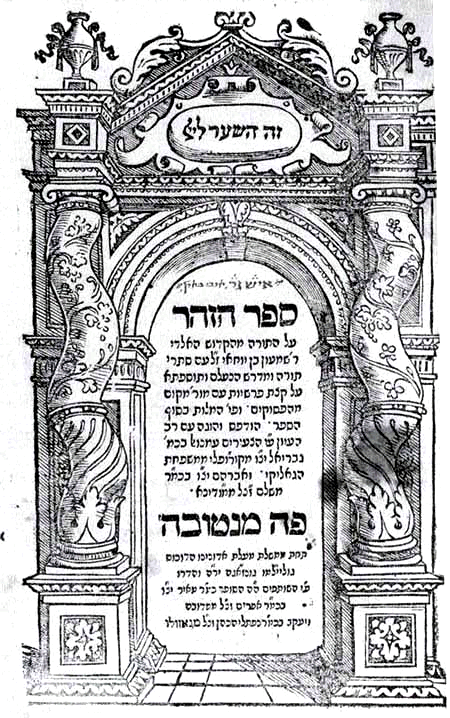
Title page of the editio princeps of the Zohar, Mantua 1558, printed at the press of Tommaso Ruffinelli. Library of Congress; public domain. The Mantua edition is one of the two near-simultaneous first prints of the Zoharic library — the other being the one-volume Cremona 1558 — and the layout it established for the Zohar’s Aramaic text shaped every subsequent edition until Matt’s Pritzker critical text three centuries later.
1. The Zohar as a library, not a book
The standard six-volume printed Zohar that circulated from Mantua 1558-1560 onward contains within it a number of distinct works whose composition, register, and editorial situation differ materially. The reader who picks up “the Zohar” picks up most or all of the following:
- Zohar proper (often called Guf ha-Zohar, “the body of the Zohar”) — the bulk of the printed work, a sustained Aramaic exegetical narrative on the Torah, framed by R. Shimon bar Yochai and his circle wandering through the Galilee and disclosing the Torah’s secret sense.
- Idra Rabba (Zohar III, 127b-145a) — the “Great Assembly,” the climactic ritual scene at which R. Shimon teaches his ten closest companions the partzuf doctrine. Three of the companions die during the disclosure.
- Idra Zuta (Zohar III, 287b-296b) — the “Lesser Assembly,” R. Shimon’s death-scene and final teaching, framed as the hilula (mystical wedding).
- Sifra di-Tzeniuta (Zohar II, 176b-179a) — the “Book of Concealment,” a brief, dense, oracular five-chapter tract on the inner divine life, which the Idrot expand and interpret.
- Sava de-Mishpatim (Zohar II, 94b-114a) — the “Old Man of Mishpatim,” a long Zoharic narrative on metempsychosis (gilgul) framed as a roadside encounter with a mysterious donkey-driver.
- Yanuka (Zohar III, 186a-192a) — the “Child,” a child-prodigy narrative delivering Torah teachings.
- Tikkunei Zohar — a separate work, longer than any single section of the Zohar proper, composed (modern scholarship agrees) by a different author later than the Zohar’s main stratum, organized as seventy tikkunim (improvements/elaborations) on the first word of Genesis (Bereshit).
- Ra’aya Mehemna (“Faithful Shepherd”) — interspersed throughout the body of the Zohar in the standard print, but identified by modern scholarship as a late-stratum work by the same author as Tikkunei Zohar.
- Midrash ha-Ne’lam (“The Hidden Midrash”) — a separately-circulating early Zoharic stratum, partly Hebrew rather than Aramaic, sometimes printed as its own work.
The list is editorial. A different inventory could organize the same material differently. What the inventory reveals is that “the Zohar” is a name for a heterogeneous corpus whose composition was distributed across multiple hands, whose registers shift between exegetical narrative, ritual-disclosure scene, oracular tract, hagiographic vignette, and later-stratum systematic elaboration, and whose received printed form is one editorial decision among others that might have been made.
2. The Moses de Leon hypothesis, from Scholem to Liebes to Abrams
The traditional attribution placed the entire Zoharic corpus on R. Shimon bar Yochai in the second century CE. The traditional account had textual support: the Zohar names R. Shimon as its central protagonist, presents itself as the record of teachings he delivered to his companions, and locates its action within identifiable Galilean geography of the tannaitic period. Medieval Kabbalistic authorities from Moshe de Leon’s own contemporaries forward accepted, with varying degrees of caution, the attribution to R. Shimon.
The modern scholarly consensus, established by Gershom Scholem and elaborated since, holds that the Zoharic corpus was composed in late-thirteenth-century Castile, principally by R. Moshe ben Shem-Tov de Leon (c. 1240-1305), with the Tikkunei Zohar and Ra’aya Mehemna stratum composed shortly after by another hand. Scholem’s argument, presented across Major Trends in Jewish Mysticism (Schocken 1941) lect. 5 and developed in subsequent essays, drew on:
- Linguistic evidence: the Zohar’s Aramaic contains thirteenth-century Spanish-influenced features inconsistent with second-century Palestinian Aramaic.
- Conceptual evidence: the sefirot system, the ten-emanation scheme, and the technical vocabulary appear nowhere in second-century rabbinic literature and are demonstrably medieval.
- Textual-historical evidence: the testimony of R. Isaac of Acre, who visited Castile after de Leon’s death seeking the original manuscripts and was told by de Leon’s widow that there were no manuscripts, only the contents of de Leon’s mind.
- Internal evidence: passages in de Leon’s signed Hebrew works parallel Zoharic teachings closely enough to suggest common authorship.
Yehuda Liebes, in Studies in the Zohar (SUNY 1993; Hebrew 1976-1991), modified the consensus. The Zohar, on Liebes’s reading, is not de Leon’s private composition but the literary product of a circle of late-thirteenth- century Castilian kabbalists organized around de Leon, with R. Yosef of Hamadan, R. Yosef Gikatilla, and others contributing material. The circle’s internal practice of attributing teachings to R. Shimon’s voice was not pseudepigraphic deception in the modern sense but a recognized literary convention in which the named ancient master functioned as the authorizing persona for the contemporary disclosure.
Daniel Abrams in Kabbalistic Manuscripts and Textual Theory (Cherub / Magnes 2010) pushed the philological argument further. Abrams’s position treats the very category of “the original Zohar text” as a methodological mistake: the Zoharic material circulated in a manuscript tradition more like a working repertoire than a finished work, the corpus was assembled in the printed editions through editorial decision rather than authorial design, and the contemporary critical task is not to recover a hypothetical Urtext but to present the manuscript variation honestly. The position is structurally parallel to Peter Schäfer’s editorial position on the Heikhalot literature (see the Heikhalot Deep sub-codex).
3. The narrative frame
The Zoharic frame story is one of the corpus’s most distinctive literary contributions. R. Shimon, his son R. Eleazar, and a circle of named companions — R. Abba, R. Yose, R. Yehuda, R. Hiyya, R. Yitzhak — wander through the Galilee. They meet on roads, in fields, in caves, at inns. A chance encounter leads to a Torah discussion; a verse triggers an esoteric elaboration; a stranger turns out to be Elijah in disguise, or an old donkey- driver, or a child of unusual learning, or the prophet Jonah in spirit-form. The narrative is loose; the linguistic register oscillates between Aramaic of remarkable lyric beauty and a more workaday exegetical Aramaic; the exegesis can be sustained for pages or dispatched in a sentence.
What the frame accomplishes editorially is that the Zohar can deliver any content the author wishes while maintaining the fiction of a documented oral tradition. R. Shimon’s voice authorizes anything attributed to it. The narrative companions provide opportunities for questions, dissent, and reformulation; the Torah-text gives the exegetical pretext. The result is a literary form remarkably well-suited to the corpus’s content. Kabbalistic teaching is doctrinally specific but performatively dramatic; the Zohar’s narrative apparatus delivers both registers at once.
Melila Hellner-Eshed’s A River Flows from Eden: The Language of Mystical Experience in the Zohar (Stanford 2009) provides the fullest literary- phenomenological reading of the frame in English. Hellner-Eshed argues that the wandering-companions structure is not narrative ornament but the formal expression of the corpus’s mystical commitment: Torah discloses itself in the encounter, on the road, in the relational space of the havurah, not in the academy or the monastery.
4. The Pritzker edition: what Matt’s critical Aramaic changed
For the entire history of Zoharic study from 1558 to 2003, the working text was the printed Mantua or Cremona edition with their seventeenth- and eighteenth-century reprints and emendations. Variant readings circulated in manuscript collections and the marginal apparatus of later prints but were not systematically available; the de facto received text was the Vilna 1882 edition with the standard pagination that subsequent scholarship continues to cite (Zohar I, II, III with folio numbers).
The Zohar: Pritzker Edition, translated and annotated by Daniel C. Matt (volumes 1-9), Nathan Wolski (volume 10), and Joel Hecker (volumes 11-12), appeared from Stanford University Press between 2003 and 2017. The edition’s contribution is not the English translation alone — substantial as that is — but the underlying critical Aramaic text that Matt established from manuscript collation before translating. For long stretches of the Zoharic corpus, the Pritzker Aramaic is the first time the text has been established critically. Matt’s choices are documented at the bottom of each page; the apparatus identifies the manuscripts consulted and the basis for the editorial decision.
What the Pritzker critical text changed is uneven across the corpus. For many passages the standard printed text was substantially correct; the critical apparatus offers refinements rather than rewrites. For other passages, particularly in the Idra material and in the Sifra di-Tzeniuta, the critical apparatus revises the printed text materially. The most consequential single change concerns the divine-anatomy passages of the Idra Rabba: Matt’s text reconstructs sequences whose printed-text corruption had generated centuries of commentarial speculation. The Pritzker apparatus allows the reader to see the corruption, the correction, and the manuscript evidence in one place.
Hekhal’s editorial position on the Pritzker edition is that it is, for the present moment, the field’s standard scholarly working text. Citations to Zoharic passages on Hekhal include the traditional Vilna pagination (Zohar I:50a, Zohar III:127b) for cross-reference to the older literature and the Pritzker volume + page reference for the critical text. Where the Pritzker reading differs from the Vilna reading materially, the difference is noted in the apparatus deck of the relevant page.
5. Sefirot, partzufim, and the Shekhinah
The Zohar inherits the ten-sefirot system from the late-twelfth- and early-thirteenth-century Geronese and Castilian Kabbalists who developed it out of the Sefer Yetzirah and the Sefer ha-Bahir. The Zoharic contribution is not the system itself but its narrative-symbolic elaboration: the sefirot become characters, with names, attributes, relationships, masculine and feminine registers, and capacities for union and separation. The two principal divine countenances at the level of the sefirot — Tiferet (Beauty), the central masculine register, and Malkhut (Kingdom), the feminine register identified with the Shekhinah — are the protagonists of the Zoharic theological drama. Their union is the divine state to which righteousness conduces; their separation is the divine state that sin produces; the Shekhinah’s exile alongside Israel is the historical-cosmic predicament.
The Zoharic Idra material recodes the sefirotic system at a deeper level into the partzuf (countenance) system. The five principal partzufim — Arikh Anpin (the Long Face, supernal mercy), Abba (Father), Imma (Mother), Zeir Anpin (the Short Face, judgment and mercy combined), and Nukva (Female) — are not a substitute for the sefirot but a recategorized view of them, in which the ten sefirot map onto the five partzufim in a defined structural way. The partzuf system is the substantive content toward which the Idra Rabba’s anatomical disclosure works. The Idra entry treats the technical apparatus.
The Lurianic doctrine three centuries later will take the partzuf system as its starting point. Without the Zoharic Idra material, Lurianic Kabbalah is not possible. The continuity is so close that one of the active questions in contemporary scholarship — pursued by Idel and Liebes — concerns whether Lurianic Kabbalah is best understood as a rupture or as a natural Zoharic unfolding.
6. The Idrot: face-to-face encounters with the divine countenances
The Idra Rabba (Zohar III, 127b-145a) and Idra Zuta (Zohar III, 287b-296b) are the corpus’s most charged ritual-disclosure scenes. The Idra Rabba opens in a field of trees; the participants are R. Shimon and ten of his companions; R. Shimon delivers the teaching; the disclosure of the divine anatomy is graduated, organ by organ, hair by hair; three of the ten companions die during the disclosure, overcome by what they are shown.
The literary register is sustained anatomical-symbolic: the hairs of Arikh Anpin’s beard are enumerated and interpreted, each carrying a specifiable theological function; Zeir Anpin’s countenance is mapped to the sefirotic registers from Chesed downward; the relations between the partzufim are described in nuptial and parental terms. The discourse is relentlessly figurative and relentlessly precise. The Idra material is not, in the apophatic sense, ineffable mysticism; it is highly articulated symbolic theology that takes the divine body as its working vocabulary.
The Idra Zuta is R. Shimon’s death-scene. The teaching is delivered as the last; the hilula (mystical wedding) is the death itself, framed not as loss but as the soul’s union with the divine. The narrative ends with the companions gathered around the master’s body; the teaching is preserved by R. Abba; the funeral is described with the same care given to the partzuf disclosure.
The Idrot were doctrinally central to Cordovero’s Zoharic synthesis and to the Lurianic recoding. Sabbatean theology made the Idra material a principal source for the anti-rational disclosure-theology Nathan of Gaza built around Sabbatai Sevi. Hasidic preaching returned to the Idrot regularly as the locus of the master-disciple disclosure-relation. The Idra material’s afterlife runs continuously from 1280s Castile to the present.
7. Tikkunei Zohar and Ra’aya Mehemna: the late stratum
Tikkunei Zohar is a separate work, organized as seventy elaborations (tikkunim) on the first word of Genesis (Bereshit). The hermeneutic operation is the medieval grammatical-symbolic move: each letter of Bereshit generates a teaching; each tikkun develops one of the seventy exegetical openings. The work is later than the Zohar proper, composed (the scholarly consensus since Scholem holds) by a different author in approximately the early fourteenth century, in Spanish-Aramaic that reads more recently than the Zohar’s main stratum.
Ra’aya Mehemna (“the Faithful Shepherd,” Moses) is by the same author. The work is interspersed throughout the printed Zohar but is editorially distinct; modern critical practice separates Ra’aya Mehemna from the Zohar proper, even though the printed editions intermix them. The Ra’aya Mehemna material is notably preoccupied with the mitzvot (commandments), the allegorical reading of the rabbinic legal apparatus, and the messianic register. Boaz Huss in The Zohar: Reception and Impact (Littman 2016) treats the late stratum in detail; the work’s reception history is distinguishable from the Zohar proper’s, and the Lurianic and Sabbatean traditions draw differently on the two strata.
8. Reception: Cordovero, Luria, Sabbateanism, Hasidism, the academy
The Zohar’s reception runs through four principal moments after its fourteenth-century circulation.
Safed, sixteenth century. Moshe Cordovero (1522-1570) produced Or Yakar (“Precious Light”), a massive Zohar commentary that runs to twenty-three volumes in its twentieth-century edition. Cordovero’s synthesizing project attempted to bring the Zoharic material into systematic order; his Pardes Rimmonim (“Orchard of Pomegranates,” Cracow 1591) became the great pre-Lurianic systematic Kabbalah, with the Zohar as its principal source. The Cordoveran achievement was the Zohar made systematically tractable; the Lurianic achievement two decades later was the Zohar made cosmogonically-actionable.
Lurianic recoding. Isaac Luria (the Ari, 1534-1572) recoded the Zoharic material through the tzimtzum-shevirah-tikkun frame. Lurianic Kabbalah is treated in its own depth in the Lurianic Kabbalah sub-codex; the present note records only that the Zoharic Idrot are the Lurianic partzufim’s textual foundation and that the Lurianic system depends on the Zoharic Sitra Achra and kelippot doctrines for its evil-and-restoration narrative.
Sabbatean reception. Nathan of Gaza (1643-1680) developed Sabbatean theology principally out of Lurianic-Zoharic material. The Zoharic Sitra Achra, the Lurianic doctrine of the descent of the divine sparks into the kelippot, and the Idrot’s narrative of disclosure-and-death together provided the apparatus by which Sabbatai Sevi’s 1666 apostasy could be recoded as a redemptive descent into the Other Side rather than as betrayal. The historical-religious-movement frame is editorially required for any treatment of this material; see the Sabbatean-Frankist sub-codex.
Hasidic appropriation. The Hasidic preachers of the eighteenth and nineteenth centuries returned to the Zoharic material constantly, though through a different filter. The Zohar in Hasidic preaching becomes less the source of cosmogonic doctrine (the Lurianic register dominates that register) and more the source of moral-psychological figures: the Shekhinah-in-exile becomes the figure of the soul’s alienation, the companions’ wandering becomes the figure of the Hasidic havurah’s devotional practice. Arthur Green’s Devotion and Commandment (HUC 1989) treats this register in detail.
Modern academy. Twentieth-century academic Zoharic studies, founded substantially by Scholem at the Hebrew University in the 1920s and 1930s, have produced the philological-historical apparatus the present sub-codex relies on. Liebes in Jerusalem, Hellner-Eshed at Hebrew University, Wolfson at NYU and then Yale, Idel at Hebrew University, Huss at Ben-Gurion, Abrams at Bar-Ilan, and Matt as the Pritzker editor have together constituted the contemporary scholarly Zoharic field. Boaz Huss in Mystifying Kabbalah (Oxford 2020) has additionally raised the methodological-critical question of whether the very category “mysticism,” which the modern academy applies to the Zohar, distorts the corpus by importing Romantic and Zionist theological concerns into what claims to be philological scholarship. The question is live and unresolved.
Reading order
For a serious reader approaching the Zohar for the first time, the recommended sequence is:
- Hellner-Eshed, A River Flows from Eden (Stanford 2009) — the literary-experiential orientation that makes the Zoharic register readable.
- The Idra Rabba in the Pritzker edition (volume 8, Stanford 2014). The most concentrated single Zoharic disclosure, with Matt’s apparatus.
- Selected passages from the Zohar on Genesis (Pritzker volumes 1-3). The Zoharic exegetical method in its sustained form.
- The Sifra di-Tzeniuta with Liebes’s commentary in Studies in the Zohar.
- The Tikkunei Zohar opening tikkunim for the late-stratum register.
- Liebes, Studies in the Zohar in full, then Huss’s Reception and Impact.
- Scholem, Major Trends lect. 5, retrospectively, as the historical document the field has subsequently elaborated.
A complementary path through the secondary literature: Scholem 1941, Liebes 1993, Hellner-Eshed 2009, Huss 2016, Abrams 2010, Wolfson 2005 (Language, Eros, Being, Fordham).
What this corpus is not
The Zohar is not Sefer Yetzirah, not Sefer ha-Bahir, not the Heikhalot literature, and not the Hekhalot expansion the Lurianic system later performs. Each of these is a distinct earlier or contemporary corpus with its own editorial law. The Zohar’s relation to them is genealogical and transformative rather than continuous. Sefer Yetzirah supplies the letter- and-number cosmology that the Zohar presupposes but does not develop in detail; Sefer ha-Bahir supplies the proto-sefirotic vocabulary that the Zohar systematizes; the Heikhalot Shi’ur Qomah supplies the divine-anatomy discourse that the Zoharic Idrot recode into symbolic register.
The Zohar is not the entirety of medieval Kabbalah. The Geronese school (Nahmanides, Ezra of Gerona, Azriel of Gerona) developed parallel and sometimes alternative Kabbalistic positions; the prophetic-ecstatic Kabbalah of Abraham Abulafia (treated in the Abulafia sub-codex) developed entirely outside the Zoharic stream; Ashkenazi Hasidism in the twelfth and thirteenth centuries developed its own theological and ritual apparatus on independent foundations. The Zohar’s centrality is a post-thirteenth-century outcome of the corpus’s reception, not a structural feature of medieval Jewish mysticism in itself.
The Zohar is not its sixteenth-century printed form. The Mantua 1558 and Cremona 1558 editions are editorial achievements that gathered manuscript material into reproducible form; they are not the witness to a single authorial original. Reading the Zohar responsibly today means reading the Pritzker critical Aramaic where available, the Mantua-Cremona printed text where the Pritzker apparatus identifies no substantive change, and the manuscript variants where the apparatus marks the variation as material. The Zohar’s textual situation is closer to the Heikhalot literature’s, in its manuscript-fluidity, than to the textual situation of a single-author philosophical treatise. The corpus rewards the labor.
Stable URLs are part of the editorial commitment. This address will not change.
Hekhal Editorial. "The Zohar and the Pritzker Edition." Hekhal: An Open Reference for Esoteric Tradition. Last modified May 15, 2026. https://hekhal.org/codex/jewish-mysticism/zohar.
Hekhal Editorial. 2026. "The Zohar and the Pritzker Edition." Hekhal: An Open Reference for Esoteric Tradition. https://hekhal.org/codex/jewish-mysticism/zohar.
Hekhal Editorial. "The Zohar and the Pritzker Edition." Hekhal: An Open Reference for Esoteric Tradition, May 15, 2026, hekhal.org/codex/jewish-mysticism/zohar.
Hekhal Editorial. (2026). The Zohar and the Pritzker Edition. Hekhal: An Open Reference for Esoteric Tradition. https://hekhal.org/codex/jewish-mysticism/zohar
@misc{hekhal-codex-jewish-mysticism-zohar-2026,
  author       = {{Hekhal Editorial}},
  title        = {{The Zohar and the Pritzker Edition}},
  year         = {2026},
  publisher    = {{Hekhal: An Open Reference for Esoteric Tradition}},
  url          = {https://hekhal.org/codex/jewish-mysticism/zohar},
  urldate      = {[date accessed]}
}