A reception essay on the apophatic core of Elliot Wolfson's Apophasis and Envisioning the Invisible (Brill, 2026), the chapters that open the book with a Christian friar set beside a Jewish philosopher. The argument is that Wolfson is describing one grammar of unsaying, carried by a real line of transmission from the Neoplatonic and Dionysian source through Maimonides into Meister Eckhart and on into the Zohar, and that Hekhal is the rare place able to show the bridge standing, because it already renders both ends of it. The essay closes where the grammar does, on the veil that reveals, and on what that asks of the work of rendering these texts at all.
One Grammar of Unsaying -- Wolfson's Apophasis from Dionysius to the Zohar
Editorial frame. The third of Hekhal’s essays on Elliot Wolfson, after the phenomenology of the imaginal and the Ḥabad essay on his self-revising gender thesis. Like those, it is reception-tier: it treats a living scholar’s argument, quotes his book only within fair use, and adjudicates nothing. Where the others read Wolfson inside the Jewish material, this one follows the bridge he builds out of it. The essay has a stake of its own, since Hekhal already renders the Christian apophatic text at the bridge’s far end — Pseudo-Dionysius’s Mystical Theology — and keeps a cross-tradition apophasis entry in its lexicon.
The bulk of Apophasis and Envisioning the Invisible (Brill 2026) is a book about Jewish mysticism. So it is worth pausing on the fact that its first chapter on a named tradition opens not with a kabbalist but with Moses Maimonides set beside Meister Eckhart, a Jewish philosopher and a Christian friar, under a single heading: the parabolic garment of truth. Wolfson says plainly why. The pairing is meant “to break down the scholarly barrier separating philosophy and mysticism.” But it does something larger than that, and the larger thing is the subject of this essay. What Wolfson calls apophasis is not a mood each tradition falls into separately when it runs out of words. It is one grammar of unsaying, carried by a real line of transmission, and the traditions Hekhal keeps apart on its shelves turn out to be speaking it together.
Plotinus→Pseudo-Dionysius→Maimonides→Meister Eckhart→the Zohar
I · The grammarApophasis is not silence
The first thing to fix, because almost everything depends on it, is what apophasis is. It is not muteness. Wolfson is emphatic, here as across his whole corpus: “if the cessation of speech is the goal,” then silence “would be the fitting response. But, in fact, the way of the mystic demands the much more difficult task of speaking the unspeakable.” His term for this, sharpened over many books, is speaking-not, which he distinguishes from mere not-speaking. Speaking-not is the gesture of speaking in order not to speak rather than not speaking in order to speak. Derrida supplies the formula the chapter leans on: “to speak in order to say nothing is not not to speak. Above all, it is not to speak to no one.” Apophasis is a verbal act addressed to another, a saying that leaves itself unsaid in the saying. Michael Sells’s name for it, which Wolfson adopts, is exact: a “language of unsaying,” a discourse of double propositions in which meaning is generated in the tension between the saying and the unsaying.
That double structure is the load-bearing beam of everything that follows, because it is what lets apophasis cross between traditions without dissolving into a vague ineffability. The deepest form of the grammar is not negation but the commingling of apophasis and kataphasis, saying and unsaying in one breath. Wolfson finds the purest early statement of it in Pseudo-Dionysius the Areopagite, the text Hekhal renders: in the Divine Names God is celebrated “as nameless and in accordance with all names.” A name above every name is nameless and yet a name nonetheless. The Mystical Theology is the discipline that holds the two together, ascending through negations to a darkness “beyond light,” to a knowing of “what is more than unknown,” and then negating even the negations — the apophasis of the apophasis, the unknowing of the unknowing. This is the grammar in its first articulation. The rest of the book watches it travel.

The first pier. Opening folio of the Dionysian corpus in Ambrogio Traversari’s Latin translation, printed Florence 1474. Biblioteca Medicea Laurenziana, Pluteo 17.23. Photograph by Sailko, CC BY 3.0. The author is pseudonymous and no portrait exists; the humanist edition that carried the corpus into early modern Europe is the appropriate referent. The Mystical Theology it transmits is the text Hekhal renders, and where the grammar of unsaying is first fully stated.
II · One source, many receptionsThe lineage, actually transmitted
The reason the bridge is more than a comparison is that Wolfson can name its piers.
The Dionysian apophasis is Neoplatonic in its bones, and Maimonides receives the same Neoplatonic stream by a different channel: the Plotiniana Arabica, the Arabic Plotinus that circulated as the Theology of Aristotle. So when Maimonides writes that “to you silence is praise” (Psalms 65:2), and that the apprehension of God consists in “our inability to attain the ultimate term in apprehending him,” he is speaking the grammar Dionysius spoke, from a shared source. Wolfson makes the link explicit rather than leaving it for the reader to infer: at the very point where he expounds the Maimonidean via negativa he quotes the Divine Names at length on “the intermingling of apophatic silence and kataphatic praise,” and refers back to his own opening chapter on Dionysius. The same commingling he found in the Christian text he finds again in the Jewish philosopher, who, like Dionysius, refuses to let the negations cancel the scriptural names outright.

The source. Roman marble bust, c. 250-300 CE, traditionally identified as Plotinus, from the Baths of the Philosopher at Ostia Antica (Museo Archeologico Ostiense). Photograph by Sailko, CC BY 3.0. The Neoplatonic One, beyond being and beyond name, is the common spring from which the apophatic grammar descends — reaching the Christian Dionysius and, through the Arabic Plotinus, the Jewish Maimonides.
Then the line runs forward, and here it is documented, not surmised. Meister Eckhart learned his negative theology in part from Maimonides. Wolfson notes “the obvious influence of the Maimonidean negative theology” on Eckhart, and the scholarship he cites traces the transmission directly. One can hear it: expounding Jacob’s unnamed “certain place” as a name for God, Eckhart says that “every word that we can say of it is more a denial of what God is not than a declaration of what He is,” and concludes that “it is a much greater thing to be silent about God than to speak” — the Maimonidean preference for silence, now in a Dominican’s mouth, reaching toward the gotheit, the naked Godhead beyond God. From Eckhart the same grammar passes, in the book’s later chapters, into the Zohar’s Ein Sof, the Limitless named by the negation of limit, the meontological “One that is not one” whose oneness is the very thing that engenders the multiple. Dionysius, Maimonides, Eckhart, the Zohar: not four ineffabilities side by side, but one language with a lineage.

The forward span. Meister Eckhart (c. 1260-1328), modern sculpture in Bad Worishofen, Germany. Photograph by Lothar Spurzem, 2012, CC BY-SA 2.0 de. Not a contemporary likeness; no fourteenth-century portrait of Eckhart survives. The Dominican’s via negativa was shaped in part by the Maimonidean negative theology — the bridge crossing here from the Jewish philosopher into the Christian preacher.
For a reader of Hekhal the lineage is not abstract. Two of its piers stand on the site already. The Mystical Theology is rendered here; the Ein Sof of the kabbalists has its lexicon entry and its place in the codex. The bridge Wolfson describes is one a reader can walk across without leaving the library.
III · The veil that revealsThe parabolic garment
What keeps this grammar from collapsing into the claim that nothing can be said is its positive half, and the positive half is the chapter’s title: the parabolic garment of truth. Maimonides holds that figurative language is strictly inappropriate to a God who has no figure, and that there is nonetheless no other way to teach, because “to discourse without metaphor would prove to be even more obscure.” Truth comes in flashes and hides again; the parable is “like someone’s removing a screen from between the eye and a visible thing.” Even Moses, on this reading, saw only through the translucent speculum, the clear partition that is still a partition; the intellect itself is “the transparent obstruction.” It is the line the whole book turns on.
There is no naked truth to behold but only truth unveiled in the veil of truth, which is to say, veiled in the veil of untruth.
This is not nihilism, and it is the essay’s reason for caring. The veil is not what hides the truth from us; it is the only thing through which the truth is given at all. “Visibility,” Wolfson writes, “is incontestably commensurate to the garment in which the body is attired.” Apophasis, taken this far, is a theory of mediated disclosure: the concealed shows itself only as concealed, the unveiling is always also a reveiling, and the garment, far from being an obstacle to the body, is the condition of seeing it. The whole cross-tradition grammar resolves into this one positive claim, which is why Dionysius can pile name upon name in the very act of denying them, why Maimonides can keep the scriptural attributes he philosophically dissolves, and why the kabbalist can write at endless length about a Ein Sof concerning which there is, strictly, nothing to write.
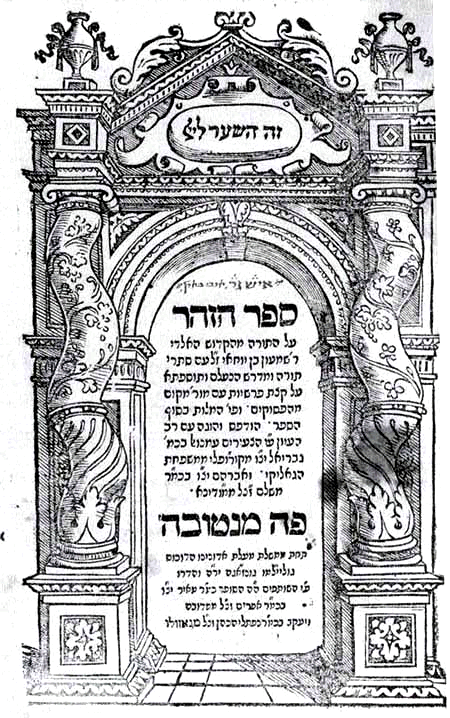
The far end. Title page of the editio princeps of the Zohar, Mantua 1558, from the press of Tommaso Ruffinelli. Library of Congress; public domain. The architectural frame — the columns and arch of a gate that at once shows and screens — is itself a figure for the parabolic garment: the Ein Sof within is named only through the veil that discloses it.
IV · The renderingWhat this asks of the texts Hekhal renders
The veil that reveals is also, exactly, a description of what a translation is.
A rendering of an esoteric primary source is a garment thrown over a body it cannot make naked. The honest ones know it. This is the wager Hekhal’s translation work was built on, and Wolfson’s apophasis gives it a name. The Targum project does not pretend to deliver the source undressed; it renders transparently and then shows the seams, the apparatus surfacing every contested word, every status flag, every place the garment pulls. That is the parabolic garment made into method: the translation displayed as a translation, the veil worn openly as a veil. The book’s own introduction reaches for the same figure, invoking Walter Benjamin on translation as the tiqqun of the broken vessels, the gathering of fragments toward a pure language no single rendering recovers. To render these texts at all is to practice the grammar this essay has been tracing, on the side of the garment rather than the silence.
So the convergence is not incidental. Hekhal renders Dionysius and renders the kabbalists; it keeps an apophasis entry that already reaches across the same traditions Wolfson bridges; and its translation engine enacts, as procedure, the mediated disclosure his book theorizes. The reading and the rendering are the same gesture seen from two sides. That is the standing claim of this site, and Wolfson’s apophasis is one of the clearest places to see why it holds.
ColophonOn this essay
A reception-tier essay on the apophatic core of a single recent book. It does not canonize Wolfson’s readings as Hekhal’s positions and it adjudicates none of the disputes internal to the traditions it crosses. It argues one thing: that Wolfson describes a single grammar of unsaying, carried by a documented line from the Dionysian and Neoplatonic source through Maimonides into Eckhart and the Zohar, and that this grammar — the veil that reveals — is also an account of what the rendering of these texts is and is not able to do. Quotations are held within fair use; the argument is the reader’s to test against the volume itself, which is the only place it is fully made.
Stable URLs are part of the editorial commitment. This address will not change.
Hekhal Editorial. "One Grammar of Unsaying -- Wolfson's Apophasis from Dionysius to the Zohar." Hekhal: An Open Reference for Esoteric Tradition. Last modified June 10, 2026. https://hekhal.org/codex/jewish-mysticism/wolfson-apophasis-bridge.
Hekhal Editorial. 2026. "One Grammar of Unsaying -- Wolfson's Apophasis from Dionysius to the Zohar." Hekhal: An Open Reference for Esoteric Tradition. https://hekhal.org/codex/jewish-mysticism/wolfson-apophasis-bridge.
Hekhal Editorial. "One Grammar of Unsaying -- Wolfson's Apophasis from Dionysius to the Zohar." Hekhal: An Open Reference for Esoteric Tradition, Jun 10, 2026, hekhal.org/codex/jewish-mysticism/wolfson-apophasis-bridge.
Hekhal Editorial. (2026). One Grammar of Unsaying -- Wolfson's Apophasis from Dionysius to the Zohar. Hekhal: An Open Reference for Esoteric Tradition. https://hekhal.org/codex/jewish-mysticism/wolfson-apophasis-bridge
@misc{hekhal-codex-jewish-mysticism-wolfson-apophasis-bridge-2026,
  author       = {{Hekhal Editorial}},
  title        = {{One Grammar of Unsaying -- Wolfson's Apophasis from Dionysius to the Zohar}},
  year         = {2026},
  publisher    = {{Hekhal: An Open Reference for Esoteric Tradition}},
  url          = {https://hekhal.org/codex/jewish-mysticism/wolfson-apophasis-bridge},
  urldate      = {[date accessed]}
}