Read the Record
A streamer asked her. She answered with the named adversary. The thirteen-year documented register the elite-fashion press has been calling avant-garde is on the public record.
A streamer approaches Michele Lamy on the street. He says, “God is good.” She replies, cold, two words.
He repeats his line. She declines to repeat his.
The clip is named here as the contemporary anchor for a thirteen-year documented register that has been hiding in plain sight on the cover of major fashion publications. The clip itself is not the load-bearing evidence. The clip is the moment the documented register escaped the elite-fashion-press reading frame and showed up as itself.
This entry reads the record.
The elite-fashion press has a standard frame for Michele Lamy. Avant-garde. Anti-muse. Fashion sorceress, but ironically. The most fascinating woman in fashion. Aesthetic radical. The frame lets the documented register sit in front of the reader, in print, for over a decade, while remaining unread. It explains everything except what she actually says.
It cannot explain a specifically-named adversarial deity offered as the substitute for the standard religious frame, on the street, in response to a stranger’s three-word evangelism prompt. It cannot explain the active refusal to repeat the standard frame when offered a second pass. It cannot explain a forty-year daily ritual line drawn down the center of a face that has been on more high-fashion covers than most working models of any generation. It cannot explain a band literally named for its founding-element fusion — LAVASCAR — whose performance practice is, in the choreographer’s own description, “a ritualistic dance exploring the relationship between the human, animal and elemental world.”
The avant-garde framing does the work of not seeing. It accommodates an open cultic register by aestheticizing it into harmlessness. This entry refuses the accommodation. The register is what it says it is.
“You wouldn’t believe how many people dressed as me for Halloween. I looked on Instagram and laughed so much. I think it’s super funny. They call me ‘the witch’, and I don’t mind that. I am the new witch.”
That is not aesthetic gesture. That is identification.
“There is something about women who are witches… This is the kind of spirit that every hopeful civilization should have.”
That is not “witches are interesting.” That is normative. It is a prescription for civilization. The fact that the prescription was published as a cover feature of a flagship art-fashion publication, opposite a Tyler Mitchell portrait, is not incidental — it is the propagative channel.
“I’ve been doing this line on my forehead for at least 40 years, every day. And now I tattooed it underneath. It equilibrates my brain.”
Asked whether she subscribed to any superstition, cult, pagan, occult, or voodoo system: “Belief is a way to express a memory of your genes.”
That is not a refusal of religion. It is a substitution of frame — a specific theory of inherited transmission as the mechanism of belief, closer in genealogy to Jung’s collective unconscious or the occult-Theosophical lineage running from Blavatsky through Crowley through Genesis P-Orridge than to anything that could be called secularism.
The choreographer Cecilia Bengolea opens the piece by quoting Lamy: “I am the only person I know who transforms myself everyday in a ritualistic way.” The performance, scored by Lamy’s band LAVASCAR, is described as “a ritualistic dance exploring the relationship between the human, animal and elemental world.”
This is not a private interior register. It has been broadcast through Neue Luxury, AnOther, Document Journal, Glamcult, System, Vogue Hong Kong, SHOWstudio, Interview Magazine, Lampoon, and rocaille — at the rate of a major published interview per year, every year, for thirteen years.
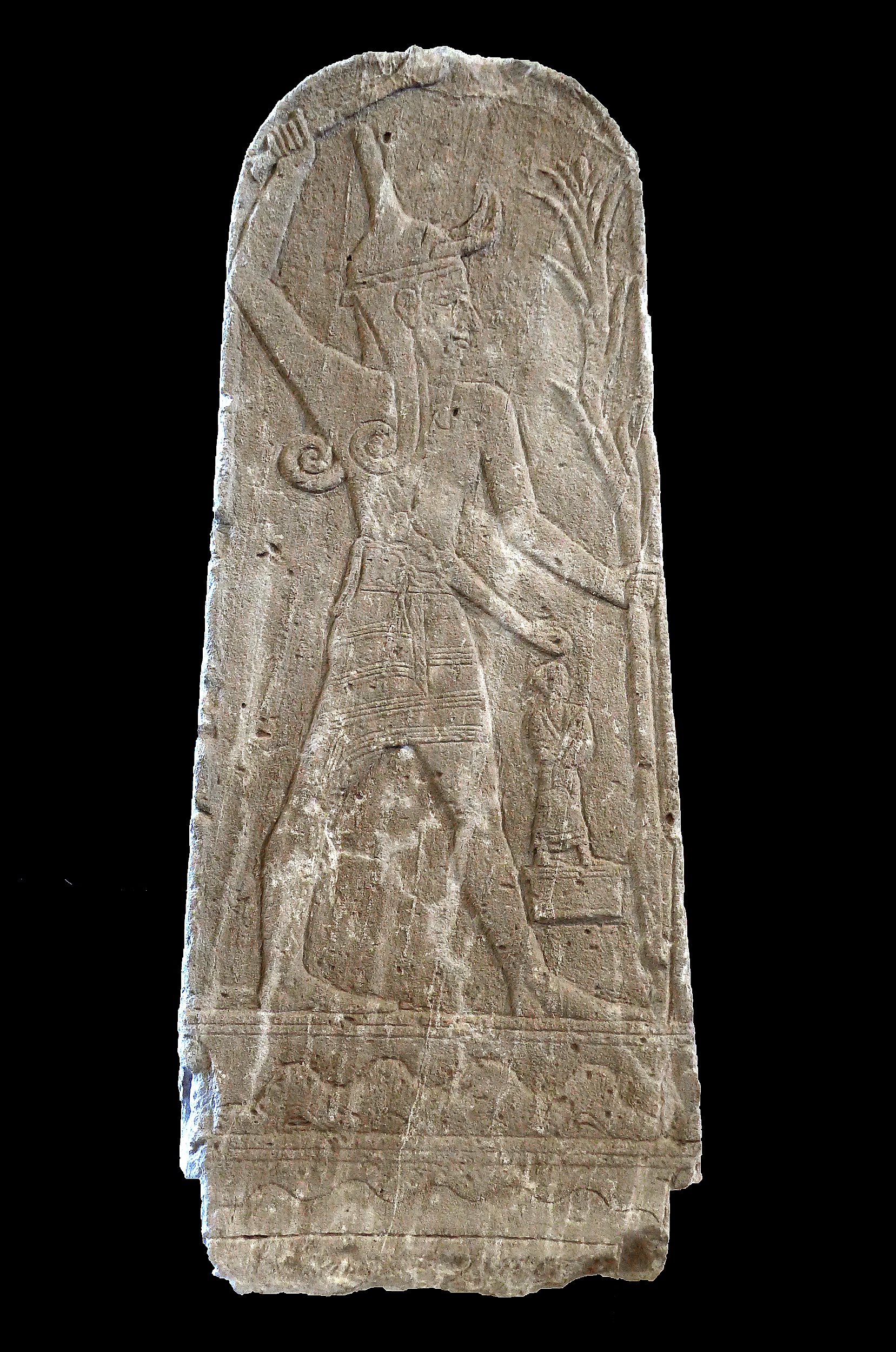
To name Baal, specifically, in response to God is good is not a generic adversarial gesture. The name carries documentary weight that requires reading.
Baal is the Northwest Semitic bʿl — “lord,” “owner,” “master” — and across the Iron Age Levantine record refers principally to Hadad, the Canaanite-Phoenician storm-and-fertility deity, whose cultus was the standing adversarial system in the Hebrew Bible’s prophetic literature.

Elijah’s confrontation with the four hundred prophets of Baal on Mount Carmel sits at 1 Kings 18. Jezebel of Sidon, whose Tyrian Baal cultus that confrontation was framed as repelling, is the named villain of 1 Kings 16-19. The prophetic polemic against Baal worship runs through Jeremiah and Hosea and structures the entire Deuteronomistic theology of fidelity-versus-apostasy. The Phoenician Baal Hadad, the Moabite-adjacent Baal Peor of Numbers 25, the demonized Baal Zebub of 2 Kings 1:2 (the figure that becomes “Beelzebub” in the Greek New Testament) — these are the documented names through which a specific adversarial cultic system is identified in the foundational scriptural record of Western religion.
Mark S. Smith’s The Early History of God (Eerdmans, 2nd ed. 2002) is the academic reference for this material; John Day’s Yahweh and the Gods and Goddesses of Canaan covers the same ground. The historiography is not contested. Baal is the named adversary.
The clip is the document. The thirteen-year register is the lineage.
Rick Owens, Lamy’s husband and the designer of the multinational fashion house they built together, runs the same register through the design language of the brand.
“I use a pentagram to represent a sort of magical and pagan playfulness. I love geometric symbols as man’s efforts to take straight lines to create a sense of order in the face of uncertainty and fear. I asked to replace the star with a pentagram. There was a strong reaction equating this with satanism, which I admit delighted me, as I have always liked to provoke rigid moralistic standards and bigotry.”
“When I use Pentagrams, it is about otherness. It is about celebrating the freak in all of us, or the young freaks out there who need support and who need encouragement and who need recognition.”

The pentagram is a documented icon of contemporary ceremonial-magick practice — its meaning in this register is sourced from the Crowleyan reception of Renaissance theurgy, not from a vacuum. Owens’ use of “pagan playfulness” is not an aesthetic alibi. It is the standard vocabulary of contemporary chaos-magick and neo-pagan currents that descend in unbroken transmission from the Golden Dawn through Crowley’s Thelema through the late twentieth-century occult revival.
The Fall/Winter 2021 collection — shown on the Lido in Venice, Italy — was named Gethsemane, after the garden in which Jesus prayed the night before his crucifixion. The collection featured pentagram-laden underwear and ritual-coded masks.
“Why are there crosses all over everyone’s houses? It’s to remind us all that Christ suffered more than anyone ever will, and in times of stress and pain, you are being reminded that someone suffered longer or more intensely than you. Suffering is something that you have to get used to, and that is why there are all those depictions of a dying man on a cross.”
That is not a household with a Christian interior register. It is a household in which the Christian iconography is openly named, framed as a pedagogy of suffering, and answered with a different system named on the runway in geometric form. The pentagram-and-cross dialectic in Rick Owens’ design language is not subliminal. It is on the press release. The press has been writing it down for twenty years.
In January 2018 Lamy opened LAMYLAND at Selfridges in London — the United Kingdom’s flagship luxury department store. The two-part installation in the Corner Shop and the Ultralounge featured a functioning boxing ring as centerpiece, performances by NTS-Radio-affiliated artists, “Raw Power” activism events, and a full working boxing gym in collaboration with Overthrow Boxing Club.
The press read this as boxing-as-empowerment metaphor. The structural reading is more specific. A combat-ritual space — a circle of confrontation under spectator gaze — was installed at the center of London’s most-trafficked luxury retail surface. It ran for three months. The artist statement framed it as transformation; the operational form was a ritualized agon staged inside the consumer-temple architecture of contemporary fashion.
In April 2024 Document Journal ran the Erykah Badu / Michele Lamy cover photographed by Tyler Mitchell. Badu, herself a long-documented public practitioner of cross-tradition spiritual currents, replies in the printed text:
“Because that’s the same reason I did mine… I wanted the mercury out of my head. And I replaced it with gold.”
The exchange — gold teeth as ritual substitution for mercury, framed by reference to mummified-Egyptian dental practice — is on the printed page of a major art-fashion publication. It is not coded. WWD covered the joint pre-Met-Gala dinner the same week.
In Autumn/Winter 2020 AnOther Magazine ran a Lamy / Kim Kardashian / Rick Owens / Kanye West joint cover project conceived and photographed by Paul Kooiker, with text by Stefan Kalmar. The published text is in fact mundane logistics and dance correspondence; the cultic-coven reading that has circulated downstream from this cover is forum speculation, not present in the published primary text. That reading does not belong here.
What does belong here is that the Document Journal Badu collaboration is on the record in the witch-spirit register, on the cover, in quotation marks. The household’s documented in-group includes that collaboration. The wider speculation about closed-circle covens of named celebrities should not be amplified from non-primary sources, and is not amplified here.
The scholarly literature on Western esotericism — Wouter Hanegraaff’s Esotericism and the Academy (Cambridge 2012), Antoine Faivre’s foundational four-criteria framework, Marco Pasi’s Aleister Crowley and the Temptation of Politics (2014), Nicholas Goodrick-Clarke’s The Occult Roots of Nazism (1985), Joscelyn Godwin’s Theosophical Enlightenment — has not, to this entry’s knowledge, treated Michele Lamy or Rick Owens as serious primary sources for the contemporary occult-cultural register. There is no Hanegraaff-grade peer-reviewed monograph on the Owens-Lamy household as a node in the contemporary esoteric current.
This absence is itself the pattern.
The academic recovery of Western esotericism from the “rejected knowledge” category that Hanegraaff documents took ninety years to enter mainstream art history (the Hilma af Klint reception); Crowley’s serious academic treatment took fifty. The treatment of currently operative contemporary esoteric currents inside elite cultural production runs three to five decades behind the operation it would describe.
The Owens-Lamy household has been propagating its register for over twenty years and is on the cover of major fashion publications annually. The academic reception is still treating it as fashion criticism. That gap — between the operation in plain sight and the scholarly recognition of it as an operation — is itself the substrate this containment board exists to document.
This is one documented case. The Owens-Lamy household is unusual only in its visibility — the register is openly on the record, repeatedly, in flagship publications, signed by the participants with their own names attached. The pattern is not unusual.
Factionalized belief systems, with named theological-occult coherence, propagate continuously through the highest-circulation surfaces of contemporary cultural production: fashion, music, fine art, finance, philanthropy, the political-theological factions in major national governments. The reading the establishment press takes of each individual case is aestheticization — the operation is treated as performance, the affiliation as gesture, the iconography as ornament. The cumulative reading of multiple cases together, with primary-source documentation per case, is the documentary record of an ongoing operation.
The Hekhal containment board will document the cases one at a time. Each entry stands on its own primary-source documentation; each entry refuses the aestheticizing frame the establishment press defaults to; each entry traces the named historical-theological lineage from which the contemporary register descends.
This entry is the first.
All verbatim quotations are sourced to a specifically named, dated published piece. The streamer-clip is flagged in epistemic status (circulating mirror, not independently authenticated primary source); the documented register surrounding the clip is the load-bearing evidence and is sourced to flagship fashion press across thirteen years.
Three corrections, against secondary literature that has circulated misattributions:
- The widely-circulated claim that Lotta Volkova was the stylist on the November 2022 Balenciaga Gift Shop and Spring 2023 Adidas campaigns is false: per Balenciaga’s official spokesperson statement to Newsweek (November 28 2022), Volkova had not worked with Balenciaga since 2018 and was not involved in those campaigns. Snopes and Logically Facts have separately rated multiple viral Volkova-images from the same November 2022 conspiracy wave as fabricated. The Balenciaga 2022 case will be documented separately on this board as a Vector C source-versus-meme entry.
- The Rick Owens FW21 Gethsemane collection was staged on the Lido in Venice, not Hollywood Forever Cemetery (a common misattribution in aggregator coverage).
- The AnOther AW20 Lamy/Kardashian cover was authored by Stefan Kalmar, not Susannah Frankel.
This entry will be revised as additional primary sources emerge. The asymmetry rule applies: the canonical Hekhal codex does not cite this surface. Cross-references travel one direction only.
Reader-contributed corrections and source-trace augmentations are welcome via the comment thread below.
Sources
- press Neue Luxury, Issue 5 -- Michele Lamy interviewed by Paul Tierney
- press Document Journal, April 29 2024 -- Erykah Badu and Michele Lamy cover feature
- press Glamcult Magazine #142, ANIMA issue, April 2025 -- Michele Lamy by Evita Shrestha
- press AnOther Magazine, December 12 2019 -- Bengolea on Lamy ritualistic dance
- press AnOther Magazine, February 20 2024 -- 50 Questions with Michele Lamy
- press rocaille.it -- Michele Lamy profile, May 23 2012
- press Culted, December 29 2021 -- Rick Owens by Stella Hughes (republished on rickowens.eu)
- press Dazed -- Rick Owens on Sissy Misfit and the pentagram
- press Highsnobiety, SS23 -- Rick Owens on the cross and Christ
- press Hero Magazine -- Rick Owens FW21 Gethsemane (Venice Lido)
- press V Magazine -- Rick Owens biblical FW21 collection
- press Hypebeast -- Michele Lamy LAMYLAND Selfridges, January 2018
- press Dazed -- LAMYLAND boxing ring at Selfridges
- press WWD -- Erykah Badu, Michele Lamy at Document Journal pre-Met dinner
- press AnOther Magazine AW20 -- Michele Lamy / Kim Kardashian cover by Paul Kooiker, text by Stefan Kalmar
- academic Wikipedia -- Michele Lamy biographical entry
- academic Mark S. Smith, *The Early History of God: Yahweh and the Other Deities in Ancient Israel*, 2nd ed., Eerdmans 2002 -- on Baal as the principal adversarial deity in Hebrew prophetic polemic
- witness TikTok -- @youwontbelievemeofficial/7438705520225176878 (circulating clip of the street exchange)
More on the containment board
browse all →Baal Is Not a Demon
A West Semitic title for "lord" was a chief Bronze Age storm-god, a Phoenician category-noun for many city-cults, and a polemic target for the Hebrew prophets. Almost everything else the term carries in modern occult and pop-cultural usage was manufactured between 1307 and 1856.
The name "Baal" carries thirty centuries of compounded meaning and almost none of it is what the modern Western imagination thinks it is. Across Ugaritic mythology, Phoenician inscriptions, Punic Carthage, Hebrew prophetic polemic, Second Temple demonology, the Templar trial of 1307, Hammer-Purgstall's 1818 Mysterium Baphometis, and Lévi's 1854 Sabbatic Goat ink drawing, distinct historical layers were collapsed by reception into a single composite "demon." This entry separates the layers, names the documents, and reads the manufacture.
Bohemian Grove: The Documented Record
A two-week summer encampment of an 1872 San Francisco writers' drinking club has become, in popular reception, a binding decision-body of the global elite engaged in ancient Druidic child sacrifice. The documented record is significantly stranger and significantly more boring than either reading.
The Bohemian Grove is a real place with a real history. It was founded in 1872 as a San Francisco journalists' fraternal club, holds its annual two-week encampment on 2,700 acres of redwood near Monte Rio, stages an opening-night theatrical pageant called the Cremation of Care first written in 1881 and standardized by 1923, and was the off-season private rental site of the September 1942 Manhattan Project planning meeting at which Leslie Groves was effectively cleared to lead the atomic project. The popular conspiracy reading (child sacrifice, Moloch worship, ancient Druid lineage, binding global-elite decision body) does not survive contact with the primary and scholarly record. The documented record (a late-Victorian theatrical convention, an aesthetic chain through eighteenth- and nineteenth-century British Druid-revival imagination, a real but bounded space of US Republican-aligned elite social cohesion) is its own kind of strange. This entry holds both readings against the documents.
Two Campaigns, Not One: The Balenciaga 2022 Receipts the Conspiracy Got Wrong
The Gift Shop bondage bears were real. The Supreme Court document was real. The stylist everyone named wasn't there. The $25M lawsuit got dropped in 48 hours.
A source-rigorous reconstruction of the November 2022 Balenciaga controversies. Documents what actually happened across two separate campaigns, names what the viral conspiracy reading misattributed, and shows what is still worth decoding once the fabrications are stripped out.
What the containment board is
How this surface differs from the canonical codex, and why
The editorial frame, asymmetry rule, source-trace requirement, and reader-comment policy for the Hekhal containment board.
Comments
Comments document reader reception. Hekhal editorial does not endorse positions taken here; the asymmetry rule applies.