Baal Is Not a Demon
A West Semitic title for lord was a chief Bronze Age storm-god, a Phoenician category-noun for many city-cults, and a polemic target for the Hebrew prophets. Almost everything else the term carries in modern occult and pop-cultural usage was manufactured between 1307 and 1856.
In contemporary anglophone usage the proper noun Baal arrives already loaded. It indexes child sacrifice, infernal fire, a horned-goat icon, a worship system that the Hebrew prophets opposed, and a satellite of Satan in the Christian demonological imagination. The composite has wide circulation: it appears in modern occult literature, in evangelical apologetics, in metal lyrics, in horror cinema, in the dialogue of tabletop role-playing games, and — with increasing frequency since 2024 — in a containment-press register applied to documented public figures who name the term as an adversarial identification.
The composite is not Bronze Age, not Iron Age, not Hellenistic, not Second Temple, and not even medieval. It was assembled over centuries from disparate strata, and a substantial portion of its present iconographic form was drawn by a single occultist’s pen in 1854. This entry sets the historical layers side by side, names the documents that fix each layer, and reads the manufacture honestly. The Hekhal containment register does not “debunk” the modern usage; the modern usage is a real social phenomenon and its propagation matters. But the term carries a documentary record older than the manufacture, and the canonical surface of Hekhal must hold that record without distortion.
The West Semitic consonantal root b--l` (𐎁𐎓𐎍 in Ugaritic alphabetic cuneiform, 𐤁𐤏𐤋 in Phoenician script, בעל in Hebrew, ܒܥܠ in Syriac) is a category-noun. Its lexical meaning is “owner,” “master,” “lord,” “possessor,” with the secondary register of “husband.” It is the relational title a Bronze Age West Semitic speaker would use for the holder of any office of mastery, divine or human. A husband is the ba’al of his wife (cf. Hosea 2:18, which puns on the term). The owner of a field is its ba’al. The patron deity of a city is its ba’al. The chief god of the Ugaritic pantheon’s working tier is the Baal — meaning, in context, the lord par excellence, the storm-god whose proper personal name is Hadad / Haddu.
This grammatical reality is load-bearing. The Hebrew Bible’s polemic plural Ba'alim (Judg. 2:11, 1 Sam. 7:4, 1 Kgs. 18:18, Hos. 2:13 and elsewhere) is not the plural of a proper name. It is the plural of a title. The Phoenician inscriptions distinguish Ba’al-Shamem (Lord of the Heavens), Ba’al-Sidon (Lord of Sidon), Ba’al-Lebanon (Lord of Lebanon), Ba’al-Saphon (Lord of Mount Sapan), and Ba’al-Hammon (the chief god of Carthage, whose epithet most likely derives from Mount Amanus, the Khamon range north of Antakya: Lipinski 1995). These are not aliases of a single deity. They are distinct city-cults of which the title b'l is the head-noun.
The English-language convention of treating “Baal” as a proper noun, with capital B, and reading it as the name of one god, is a Hebrew-prophetic-polemic convention transmitted through the Septuagint and the Vulgate into Christian-European linguistic habit. The prophets condemned the Ba’alim generically because their polemic was generic; the Phoenician and Punic and Aramaic worshippers of those Ba’alim did not experience them as a single religion.
The longest surviving religious composition from the Late Bronze Age West Semitic world is the so-called Baal Cycle, recovered from the archives of the city of Ugarit (Ras Shamra on the coast of modern Syria) and preserved on six clay tablets catalogued KTU 1.1 through 1.6, dating to approximately the fourteenth or thirteenth century BCE. The critical edition with English translation and commentary is Mark S. Smith’s two volumes from Brill (The Ugaritic Baal Cycle, vol. I, 1994; vol. II with Wayne T. Pitard, 2009), the standard reference cited across the field.
The narrative arc, summarized from Smith 1994 and Smith-Pitard 2009:
KTU 1.1 and 1.2 stage the conflict between Baal and Yamm, “Sea.” Yamm claims divine kingship; Baal contests it. The craftsman god Kothar-wa-Khasis forges two clubs, Yagrush (“driver”) and Ayamur (“expeller”); Baal strikes Yamm and prevails. KTU 1.3 and 1.4 trace the diplomatic consequences. Anat and Athirat intercede with El (the senior god of the Ugaritic pantheon, often translated “the Bull” or “the Father”) on Baal’s behalf, and Baal is granted permission to build a palace of cedar, silver, and gold on Mount Sapan (Jebel al-Aqra, on the modern Syrian-Turkish border, the divine mountain of the Ugaritic geography). KTU 1.5 and 1.6 stage the second crisis: Baal descends into the underworld at the summons of Mot (“Death”); the land withers; Anat searches for Baal, finds his body, and slaughters Mot (“she winnows him with a winnowing-fan,” KTU 1.6 II.31-35); Baal is restored and rains return.
The older Frazerian reading — Baal as a calendrically-fixed dying-and-rising vegetation god of the Adonis-Tammuz family — has been substantially qualified in the contemporary field. Smith 1994 and Smith 2001 read the Mot conflict as a seasonal-royal narrative with its own internal cosmology rather than as the regular cycle of an agricultural ritual; Day 2000 chapter 4 surveys the modifications. The Baal of the Ugaritic Cycle is a storm-god of cosmic kingship, not a corn-spirit.
Baal’s standing epithets in the Cycle include aliyn b’l (“Mighty Baal”), zbl b’l ars (“Prince, Lord of the Earth”), and rkb ‘rpt (“Cloud-Rider”). The last is significant downstream: the Hebrew Psalter appropriates it for Yahweh at Psalm 68:5 (rokev ba’aravot, “rider on the clouds”), and the appropriation is one of the cleanest cases of what Smith 2002 calls convergence — the absorption of Canaanite divine attributes into the developing Yahwistic monotheism. The Hebrew prophets condemn the Baal cult; the Hebrew Psalter dresses Yahweh in Baal’s iconography. Both moves are happening in the same scriptural corpus simultaneously.
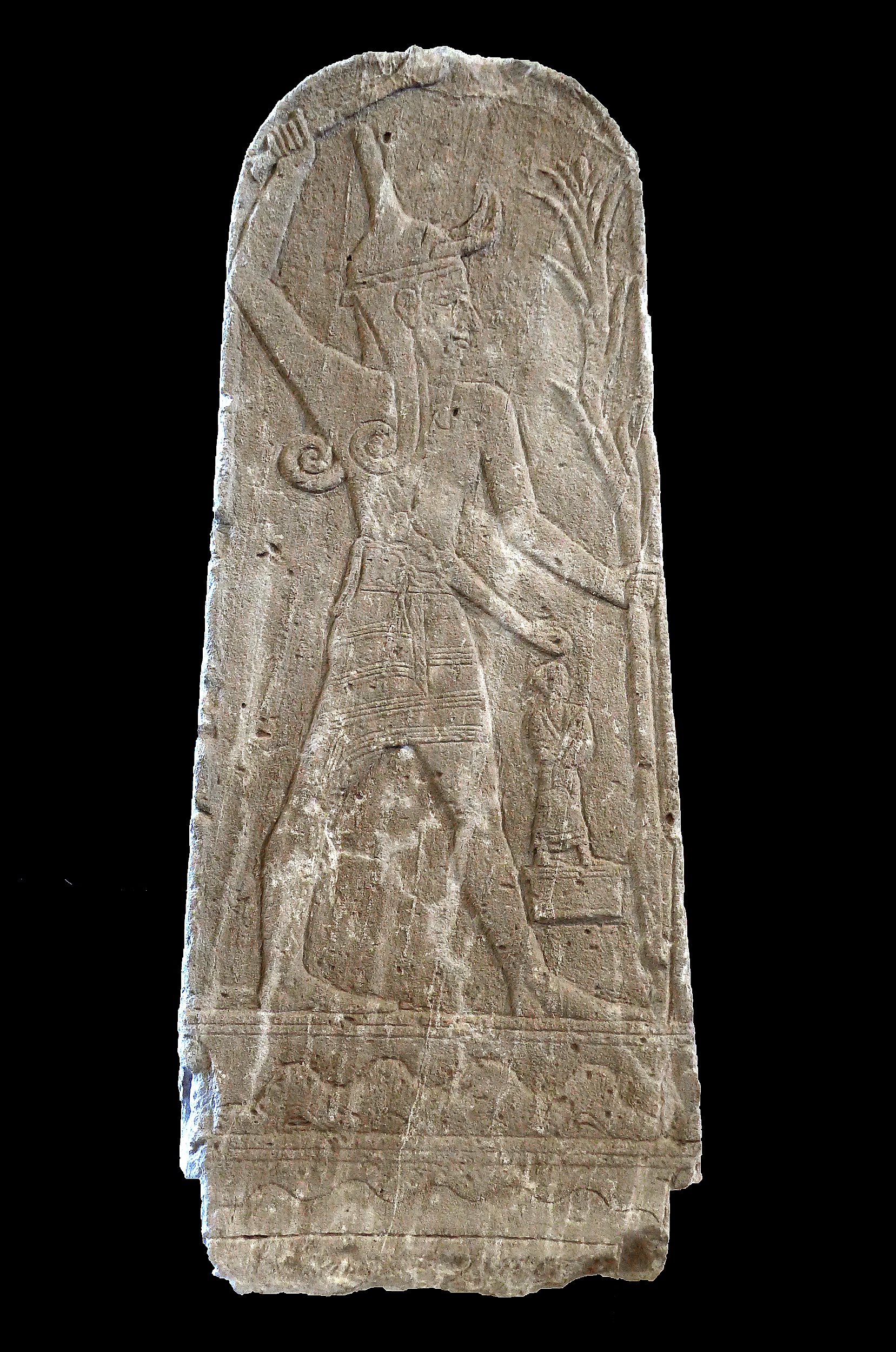
The Stele of Baal with Thunderbolt at the Louvre (AO 15775), recovered from the temple-of-Baal area at Ras Shamra in 1932, is the canonical iconographic anchor for this stratum. It is the historical Baal-Hadad, the figure of the Ugaritic Cycle. It is not a demon. It is a Bronze Age West Semitic chief god of storm and kingship.
When the Late Bronze Age ends and the city-states of the Phoenician coast (Byblos, Sidon, Tyre, Arvad, Berytus) come into their own in the early first millennium BCE, the unitary chief Baal of Ugarit becomes a category under which the city-Baals are distinguished. The Phoenician inscriptional corpus — catalogued in Donner and Röllig’s Kanaanäische und Aramäische Inschriften (KAI), the standard epigraphic reference — distinguishes the Baal-cults by epithet:
- Ba’al-Shamem, “Lord of the Heavens” (KAI 4, the Yehimilk of Byblos inscription, c. tenth century BCE; KAI 26, the Karatepe bilingual Phoenician-Luwian, eighth century BCE, where Azitiwada invokes
b'l smmalongside El-Creator-of-the-Earth). - Ba’al-Sidon, the patron god of the city of Sidon (KAI 14, the Eshmunazar II sarcophagus).
- Ba’al-Lebanon, attested in the bronze-bowl inscription KAI 31.
- Ba’al-Hammon, the chief god of Punic Carthage (see next section).
- Ba’al-Saphon / Ba’al-Sapan, the mountain-Baal of the Ugaritic Cycle carried into the Phoenician corpus (KAI 50).
- Ba’al-Melek and Ba’al-Roesh as occupational epithets (“Lord-King,” “Lord of the Head”) in scattered inscriptions.
The Phoenicians distinguished these cults locally. A Sidonian devotee of Ba’al-Sidon did not understand his deity as identical with the Carthaginian Ba’al-Hammon or the Byblian Ba’al-Shamem in the way a modern reader of a translated Hebrew Bible imagines a single supranational Baal-religion. The category-noun governance of b'l is the structural fact the Hebrew polemic erases.
The Punic colony of Carthage (founded by Tyrian Phoenicians, traditional date 814 BCE, destroyed by Rome 146 BCE) and the related sites Motya, Sousse, Tharros, and Constantine all yielded, in excavations beginning in the 1920s, enclosed precincts containing thousands of urns. The urns hold cremated remains of human infants and young animals, often capped by votive stelae dedicated to Ba’al-Hammon and Tanit (the latter epitheted pn b’l, “Face of Baal”). The Carthage precinct is the so-called Tophet in the Salammbo district. The technical Punic term in many of the dedicatory inscriptions is mlk (cognate with Hebrew molekh and moloch).
The interpretation is contested. Three positions:
Sacrifice reading. Stager and Wolff 1984 (Biblical Archaeology Review 10/1) argued the tophet is a sanctuary in which infants and young animals were ritually sacrificed, the offering identified by the technical term mlk. The interpretation is partly grounded in the classical sources — Diodorus Siculus 20.14, Plutarch De superstitione 13, Tertullian Apologeticus 9 — which describe Punic child sacrifice. Stager-Wolff estimated as many as 20,000 urns across the precinct between roughly 400 and 200 BCE. The number is a cumulative depositional estimate over two centuries, not an annual rate; the latter compression is a modern-popular distortion.
Cemetery / infant-mortality counter-reading. Schwartz, Houghton, Macchiarelli, and Bondioli published in PLoS ONE 5(2) (2010) an osteological re-examination arguing that the age-at-death distribution in the urns is consistent with peri-natal and infant mortality, not a culled sacrificial cohort, and that the tophet was a special infant cemetery rather than a sacrificial precinct. Schwartz et al. 2012 (Antiquity 86) extended the analysis.
Reaffirmation of sacrifice with refined methods. Smith, Avishai, Greene, and Stager 2011 (Antiquity 85) and Xella, Quinn, Melchiorri, and van Dommelen 2013 (Antiquity 87) responded that age-at-death estimation methods on cremated remains tend to under-age the sample, and that the epigraphic and classical evidence remains positive for at least some sacrificial activity. Their position is that “cemetery” and “sacrifice” are not mutually exclusive: a precinct can be both.
The honest framing as of 2026: the classical sources allege Punic child sacrifice; the archaeology is contested; the maximalist 20,000-per-year folk number is wrong by two orders of magnitude even on the most sacrificial reading; the debate is live. What the Carthage record does not support is the popular meme of “the Baal cult sacrificed children.” It supports, at most, “one Phoenician city-cult dedicated to Ba’al-Hammon and Tanit included a precinct whose interpretation as sacrificial is still actively contested in the peer-reviewed literature.”
The Hebrew Bible names at least four distinct Baal-cults specifically, plus the polemic plural Ba'alim. Day 2000 (Yahweh and the Gods and Goddesses of Canaan) is the load-bearing modern study.
Baal-Peor (Num. 25:1-9; Deut. 4:3; Ps. 106:28; Hos. 9:10). A Moabite cult located at Beth-Peor, the site where the Hebrew narrative places the apostasy of the Israelites under the influence of Moabite women. Day 2000 (pp. 110-114) reads this as a localized West Semitic Baal-Hadad form, not a Moabite deity wholly distinct from the broader Levantine stratum.
Baal-Zebub of Ekron (2 Kgs. 1:2-16). The Philistine god of Ekron whom King Ahaziah, injured in a fall, consults about his recovery prospects. The Hebrew form b'l zbb (“Lord of Flies”) is almost certainly a polemical distortion. The plausible original is b'l zbl, “Prince Baal,” an epithet directly attested at Ugarit as zbl b'l ars (Smith 1994). The vocalic shift turns “prince” into “flies” — a pun encoding contempt. Day 2000 (pp. 77-78) gives the standard treatment. The variant Beelzeboul preserved in the Greek manuscript tradition of the New Testament (Mark 3:22, Matt. 10:25, Matt. 12:24, Luke 11:15-19) preserves the original Ugaritic zbl in a way the Hebrew polemic distortion does not. The “Beelzebub” form familiar from the Vulgate and from English Bibles is the secondary, polemical form.
Baal-Berith of Shechem (Judg. 8:33, 9:4, 9:46 where the variant El-Berith appears). “Lord of the Covenant.” Day 2000 (pp. 119-121) connects this with a treaty-Baal cult at Shechem, the West Semitic deity of covenanted alliance, with the Judg. 9 variant suggesting an El-Baal compound figure in the local cult.
The Tyrian Omride cult. The Elijah cycle (1 Kgs. 17-19) and the broader Jezebel material (1 Kgs. 16, 2 Kgs. 9-10) target a specifically Tyrian / Sidonian Baal-cult that Jezebel of Sidon imported under the Omride dynasty. The deity is plausibly Ba’al-Shamem or Melqart (Day 2000 pp. 75-77); the question is unresolved. The Mount Carmel showdown of 1 Kgs. 18, in which Elijah confronts and then slaughters the four hundred and fifty prophets of Baal, is the iconic scene of Israelite prophetic confrontation with the imported cult.

What the Hebrew Bible does not name is a unitary supranational Baal-religion. It names four (or more) specific city-cults, plus the polemic plural that lumps them. The lumping is the work of the polemic, not the structure of the cults.
Mark Smith’s two synthetic volumes — The Early History of God (2nd ed. 2002) and The Origins of Biblical Monotheism (2001) — model the long arc by which Yahweh and Baal are constructed in opposition. Smith’s two-phase frame:
Convergence. In the period before and around the eighth century BCE, qualities of El, Asherah, and Baal are absorbed into the developing portrait of Yahweh. Yahweh inherits El’s seniority and his patriarchal-creator framing; Asherah survives as a divine consort in inscriptional evidence (Kuntillet Ajrud, Khirbet el-Qom) before being later excised; and Baal’s storm-and-cloud-rider imagery is dressed onto Yahweh. Psalm 68:5 (rokev ba'aravot) is the cleanest single case. Psalm 18, Habakkuk 3, and Deuteronomy 33 all carry Baal-derived storm-theophany imagery applied to Yahweh.
Differentiation. Beginning in the late ninth century BCE and accelerating through the eighth-century prophets, Baal is then cast as the disqualified rival. The same Yahweh whose Psalter has just appropriated Baal’s epithets becomes, in Hosea and Jeremiah, the deity in whose mouth Baal is the named enemy.
Way-stations of the differentiation arc:
- Late ninth century BCE. The Elijah-Jezebel cycle as the literary apex of the confrontation with the Tyrian Baal.
- Eighth-seventh centuries BCE. Prophetic invective at scale — Hosea 2 (and the pun on
ba'ali/ “my husband” versus'ishi/ “my husband” without the Baal-resonance), Jeremiah 2, 7, 11, 19, 23, 32. The prophets work the term hard. - Seventh-sixth centuries BCE. The Deuteronomistic redaction. The plural
Ba'alimbecomes the standard polemic shorthand for any-and-all foreign cult. The category-noun nature ofb'lis what makes the rhetorical move possible. - Third-second centuries BCE. The Septuagint. Translation choices interpose generic Greek terms (e.g., feminine
tē Baalin some passages) that further occlude the specific local-cult referents. - Second Temple period. Deuteronomy 32:17 (“They sacrificed to demons, not to God; to gods they had not known”) and Psalm 106:37 are read in the late Second Temple period as identifying foreign gods with shedim, “demons.” 1 Corinthians 10:20 — “what the Gentiles sacrifice they sacrifice to demons and not to God” — inherits this reading and projects it onto Greco-Roman cult. This is the first stratum at which “Baal” begins to mean, in some interpretive registers, “demon.”
- New Testament. The form
Beelzeboulenters as the name of a chief of demons (Mark 3:22, Matt. 12:24, Luke 11:15-19). The text-critical situation favors the GreekBeelzeboul— preserving the Ugaritic zbl in Hellenistic transmission — over the Vulgate’sBeelzebub. The “chief of demons” function is the Second Temple demonological assumption applied to the inherited polemic term. - Rabbinic and patristic literature. The Testament of Solomon (third-fourth century CE pseudepigraphon) lists Beelzeboul as ruler of demons and gives him a full taxonomy of subordinates. Origen and other patristic readers absorb the inheritance.
The “Baal is a demon” reading is, then, a Second Temple and post-Second-Temple reading. It is at least one full millennium downstream of the historical Bronze Age storm-god Baal-Hadad. The polemic-to-demonology pipeline is a documented historical process, not a hidden truth.
The term Baphomet first appears in the historical record in the documents of the Templar trial of 1307-1314. The trial was initiated by Philip IV of France, executed by the French Inquisition, and partly endorsed by Pope Clement V; the standard modern study is Malcolm Barber’s The Trial of the Templars (2nd ed., Cambridge University Press, 2006). Peter Partner’s The Murdered Magicians (Oxford, 1981) is the indispensable secondary treatment of the trial’s mythography across the subsequent five centuries.
The confessions extracted from the arrested Templars under torture name various heretical practices: spitting on or trampling the cross at initiation, kissing brothers on the navel or buttocks, denying Christ, and worshipping an idol variously described as a head, a cat, a three-faced figure, or a bearded man. Among the trial’s vocabulary the term Baphomet / Bafomet / Baffomet appears in several confessions, typically as the name of the idol. The philological consensus on the term, summarized in Barber 2006 chapter 3, is that it is the Old Occitan / Old French corruption of Mahomet — the Western European medieval-polemical projection of an “idol of the Saracens” onto the Templars, who were associated by trial-narrative with the eastern Mediterranean and with cross-confessional contact.
In other words: the term that nineteenth-century occultism would later identify with Phoenician Baal-Hadad was originally, in its first documented appearance, a confessor-under-torture’s mispronunciation of the name of the Prophet Muhammad, deployed by Inquisitorial scribes inside a polemical-Crusading frame.
No direct philological line, no inscriptional continuity, no cult-archaeological evidence connects the 1307 trial-term Bafomet to Iron Age Phoenician Ba’al. The two terms share initial consonants and a vowel; they share nothing else. The composition of the modern composite that yokes them is a documented later event.
The first synthetic European literary treatment of Baphomet as a Gnostic-cult term is Joseph Freiherr von Hammer-Purgstall’s Mysterium Baphometis revelatum, seu Fratres Militiae Templi, qua Gnostici et quidem Ophiani, Apostasiae, Idoloduliae et Impuritatis convicti, per ipsa eorum Monumenta, published in 1818 as volume 6 of the orientalist serial Fundgruben des Orients (Vienna).
Hammer-Purgstall argued, on the basis of certain reliquary heads, casket figures, and architectural details he assembled from European collections and identified as Baphomets, that the Knights Templar had been a Gnostic / Ophite sect engaged in heterodox worship and ritual impurity. The thesis was sweeping: he proposed the Templars as a continuous Gnostic underground transmitting Late Antique heretical theology into medieval Christendom under the cover of crusading orthodoxy.
The subsequent scholarship — Partner 1981, Barber 2006, and a long line of intermediate work — has been clear that the thesis is wrong in two related ways. First, several of the objects Hammer-Purgstall used as his iconographic dataset have been shown to be either misidentified (later artifacts misdated to the Templar period) or wholly post-medieval. Second, even on the trial documents alone, the Inquisitorial confessions describe an inconsistent and torture-induced testimony incompatible with the systematic Gnostic-Ophite program Hammer-Purgstall built from them.
But the Mysterium did circulate. It established, in the European literary imagination, that Baphomet was a real ancient cult-object, that the Templars had worshipped it, and that its theology was Gnostic-Ophite — which is to say, dualist, demiurgic, and heterodox in a way that could be read backward into Bronze Age “Canaanite” religion if one chose. Hammer-Purgstall did not himself draw the line back to Baal-Hadad. The line was drawn by his successor.
Alphonse-Louis Constant (1810-1875), writing under the Hebrew-derived pseudonym Éliphas Lévi, published Dogme de la Haute Magie (1854) and Rituel de la Haute Magie (1856), later combined as the two-volume Dogme et Rituel de la Haute Magie. Lévi was a former Catholic seminarian, a polymathic synthesizer of Hermetic-Kabbalistic-Tarot symbolisms, and one of the foundational figures of the nineteenth-century French occult revival. Dogme et Rituel is the book in which modern occultism’s standard symbolic vocabulary — Tarot trump-to-Hebrew-letter correspondences, the four elemental tools of ritual magic, the magus-figure with raised right hand and lowered left — was assembled into a coherent system for the first time.
Lévi included in the Rituel his own ink drawing labelled “Le Baphomet de Mendès” / the Sabbatic Goat. The figure is winged, breasted, torch-headed, goat-anthropoid, with one hand raised and one lowered, and with the Latin words SOLVE (“dissolve”) and COAGULA (“congeal”) inscribed on the forearms. The image is now ubiquitous; it appears in occult publications, in heavy-metal album art, on Satanic Temple ritual surfaces, on horror-movie posters, and (in inverted-pentagram derivative form) as the standard “Sigil of Baphomet” of LaVeyan Satanism.
The crucial point about Lévi’s frame is that he himself names it symbolically, not archaeologically. The Sabbatic Goat is, in Lévi’s text, an emblem of binary equilibrium synthesizing alchemical, Kabbalistic, and Hermetic symbol-sets: light and dark, ascending and descending, masculine and feminine, dissolution and coagulation. The torch is intellectual fire. The wings are the volatile principle of alchemy. The breasts and the male body together image the conjunction of opposites that is Hermetic equilibrium. The pentagram on the forehead is Lévi’s standard sigil of the human-microcosmic governance of the four elements plus spirit.
Lévi does not claim that his image is a historical reconstruction of any ancient Templar idol or any Phoenician deity. He synthesizes the term (which he takes from Hammer-Purgstall’s tradition) with his own iconographic-Hermetic program. The line from Iron Age Phoenicia to Lévi’s pen is drawn through Hammer-Purgstall’s flawed thesis and through the loose nineteenth-century European habit of treating “Baal” as a generic term for “pagan adversary.” It is not drawn through any documented continuity of cult, of iconography, or of textual transmission.
The Sabbatic Goat is therefore a French Romantic-occult invention of 1854. It is not a Bronze Age Phoenician artifact, not a Templar relic, not a Gnostic-Ophite cult-object, and not a documented historical depiction of any deity named Baal. It is Lévi’s drawing.
The Sabbatic Goat became, over the twentieth century, the standard iconographic anchor for the modern composite “Baal-demon-Baphomet” image, even though that composite is a layered manufacture and each layer has documentary problems. Three reception points worth naming briefly:
Aleister Crowley (1875-1947) absorbed the Lévi imagery into his Thelemic synthesis, identifying Baphomet with various of his own magical names (including his title as Outer Head of the Ordo Templi Orientis from 1922). Crowley read the figure through his own Egyptian-Kabbalistic-sex-magick frame, not through Phoenician Baal-Hadad. His treatment is consciously synthetic.
Anton LaVey and the Church of Satan (founded 1966) adopted an inverted-pentagram-with-goat-head sigil derived from the Lévi imagery as the “Sigil of Baphomet,” now the de facto trademark of LaVeyan Satanism. LaVey’s frame is materialist-atheist; the symbol’s content is rhetorical-adversarial.
The Satanic Temple (founded 2013) commissioned, in 2014, a bronze sculpture of Baphomet flanked by two children for proposed installation in public spaces as a First Amendment counter-test to Ten Commandments monuments. The Hartford-cast bronze is a direct contemporary descendant of the Lévi 1854 ink drawing, iconographically more elaborate but downstream of the same image. The Satanic Temple’s frame is non-theistic and politically-strategic.
None of these reception points connect, by any documented historical line, to the Phoenician Baal-Hadad of the Ugaritic Baal Cycle. The connection that contemporary readers assume runs from Bronze Age Phoenicia to LaVey’s altar is, on the documentary record, a chain of literary inventions, polemical projections, and iconographic borrowings whose first secure datum is the 1307 Templar trial and whose decisive synthesis is Lévi’s 1854 drawing.
A compressed corrections table, expanded from the research synthesis at research/passes/a1-baal-levant/findings.md §7:
| Popular claim | Documented record |
|---|---|
| ”Baal” is one god, a demon of fire and child sacrifice. | ”Baal” (b'l) is West Semitic for “lord / master.” The Ugaritic corpus has a chief Baal = Hadad. Phoenician and Punic inscriptions distinguish many Baal-cults by epithet. (Smith 1994; Lipinski 1995) |
| The Hebrew Bible names a single Baal. | The Hebrew Bible names at least Baal-Peor, Baal-Zebub of Ekron, Baal-Berith of Shechem, the Tyrian Baal of the Omrides, and the polemic plural Ba'alim. (Day 2000) |
| Carthaginians sacrificed 20,000 babies a year. | Stager-Wolff 1984 is a cumulative depositional estimate over two centuries, not an annual rate; the sacrificial interpretation itself is contested by Schwartz et al. 2010 and 2012. Debate live as of 2026. |
| ”Baphomet” is the Templars’ worship of Baal. | ”Baphomet” enters the record in 1307 Templar confessions under torture; most likely Old French / Old Occitan corruption of Mahomet. Hammer-Purgstall 1818 built a Gnostic-Templar thesis on misidentified objects. (Barber 2006; Partner 1981) |
| The Lévi 1854 goat-image is an ancient Baal portrait. | It is Lévi’s own ink drawing, presented in Dogme et Rituel as a Hermetic-alchemical emblem of equilibrium synthesizing SOLVE and COAGULA, not as an archaeological reconstruction. (Lévi 1854 / 1856) |
| “Beelzebub” / “Beelzebul” is the proper name of Satan’s lieutenant inherited from the Old Testament. | Beelzeboul (NT, dominant text-critical reading) most plausibly preserves the Ugaritic-attested epithet zbl b'l (“Prince Baal”). Beelzebub (“Lord of Flies,” 2 Kgs. 1) is a Hebrew polemical distortion of that original. The “demon” identification is Second Temple and later. (Day 2000; Smith 2002) |
| Modern self-identification with “Baal” connects the speaker to a Phoenician cultic system. | On the documented record, the connection runs through Hammer-Purgstall 1818 and Lévi 1854, not through Bronze Age Phoenicia. The Phoenician cult system did not survive in any continuous lineage into modernity. What survives is the Hebrew prophetic polemic and the literary-occult reconstruction. |
Where the popular meme is wrong, it is wrong by collapsing distinct historical layers (Late Bronze Ugarit; Iron Age Phoenicia; Punic Carthage; Iron Age Israelite polemic; Second Temple demonology; medieval anti-Saracen polemic; nineteenth-century occult synthesis) into one undifferentiated “Baal-demon” image. The corrective is layered separation. Hekhal’s editorial discipline is to keep the layers separate.
The term Baal, today, is doing two distinct kinds of work that the Hekhal containment register treats separately.
As an honest reference to the documented record. A Bronze Age scholar discussing the Ugaritic Baal Cycle is referring to the chief storm-god Hadad of the KTU 1.1-1.6 corpus, the cloud-rider whose iconography survives in the Stele of Baal with Thunderbolt. A Phoenician epigrapher discussing KAI 14 is referring to the patron deity of fifth-century BCE Sidon. A Hebrew Bible scholar discussing 1 Kings 18 is referring to a Tyrian cultic system imported by Jezebel. A New Testament scholar discussing Mark 3:22 is referring to the Second Temple Jewish demonological frame inherited by the Synoptic tradition. Each of these references picks out a different historical stratum, and each is legitimate within its stratum.
As a contemporary self-identifying gesture. When a contemporary public figure — in the Lamy case documented on hekhal, or in the broader pattern of self-described witches, occultists, or adversarial-religious identifiers — names Baal as the deity they affiliate with, the speaker is on the documented record drawing from the Lévi-Crowley-LaVey-Satanic-Temple lineage of nineteenth-and-twentieth-century occult reconstruction, not from any continuous Phoenician cultic tradition. The historical Baal-Hadad cult ended with the collapse of the Phoenician city-states and the Roman destruction of Carthage. What survives is the literary-occult image. The contemporary identifier is naming that image, not the storm-god of Mount Sapan.
The Hekhal canonical register holds the Ugaritic, Phoenician, Punic, and Hebrew-prophetic strata together with the documents that fix each. The Hekhal containment register holds the literary-occult image with the named authors who manufactured it. The two should not collapse into one another, and the popular composite that does collapse them is, as a historical reading, wrong. As a social phenomenon — as a register of contemporary self-affiliation, especially in elite cultural production — it is a real object of study, and worth reading carefully, but it is not the same object as the Bronze Age storm-god.
Baal is not a demon. Baal is a category-noun, a chief Bronze Age storm-god, a plurality of Phoenician city-cults, a polemic target of the Hebrew prophets, a Second Temple demonological recasting, a medieval Inquisitorial mispronunciation of Mahomet, an 1818 Romantic-orientalist literary thesis, and an 1854 French occult ink drawing. The composite is younger than the steam engine.
The documents are the record.
Sources
- academic Mark S. Smith, *The Ugaritic Baal Cycle*, Vol. I (KTU 1.1-1.2), Brill VTSup 55, 1994
- academic Mark S. Smith and Wayne T. Pitard, *The Ugaritic Baal Cycle*, Vol. II (KTU 1.3-1.4), Brill VTSup 114, 2009
- academic Mark S. Smith, *The Early History of God: Yahweh and the Other Deities in Ancient Israel*, 2nd ed., Eerdmans, 2002
- academic Mark S. Smith, *The Origins of Biblical Monotheism: Israel's Polytheistic Background and the Ugaritic Texts*, Oxford University Press, 2001
- academic John Day, *Yahweh and the Gods and Goddesses of Canaan*, JSOTSup 265, Sheffield Academic Press, 2000
- academic Edward Lipinski, *Dieux et déesses de l'univers phénicien et punique*, Studia Phoenicia XIV, Peeters, 1995
- primary Herbert Donner and Wolfgang Röllig, *Kanaanäische und Aramäische Inschriften* (KAI), Harrassowitz, 5th ed., 2002
- academic Lawrence E. Stager and Samuel R. Wolff, 'Child Sacrifice at Carthage--Religious Rite or Population Control?', *Biblical Archaeology Review* 10/1, 1984, pp. 30-51
- academic Jeffrey H. Schwartz, Frank Houghton, Roberto Macchiarelli, Luca Bondioli, 'Skeletal Remains from Punic Carthage Do Not Support Systematic Sacrifice of Infants', *PLoS ONE* 5(2), 2010, e9177
- academic Patricia Smith, Gal Avishai, Joseph A. Greene, Lawrence E. Stager, 'Aging Cremated Infants: The Problem of Sacrifice at the Tophet of Carthage', *Antiquity* 85, 2011, pp. 859-874
- academic Paolo Xella, Josephine Quinn, Valentina Melchiorri, Peter van Dommelen, 'Phoenician Bones of Contention', *Antiquity* 87, 2013, pp. 1199-1207
- academic Malcolm Barber, *The Trial of the Templars*, 2nd ed., Cambridge University Press, 2006
- academic Peter Partner, *The Murdered Magicians: The Templars and Their Myth*, Oxford University Press, 1981
- primary Joseph von Hammer-Purgstall, *Mysterium Baphometis revelatum*, in *Fundgruben des Orients* vol. 6, Vienna, 1818
- primary Eliphas Lévi (Alphonse-Louis Constant), *Dogme et Rituel de la Haute Magie*, Paris, 1854-1856
More on the containment board
browse all →Bohemian Grove: The Documented Record
A two-week summer encampment of an 1872 San Francisco writers' drinking club has become, in popular reception, a binding decision-body of the global elite engaged in ancient Druidic child sacrifice. The documented record is significantly stranger and significantly more boring than either reading.
The Bohemian Grove is a real place with a real history. It was founded in 1872 as a San Francisco journalists' fraternal club, holds its annual two-week encampment on 2,700 acres of redwood near Monte Rio, stages an opening-night theatrical pageant called the Cremation of Care first written in 1881 and standardized by 1923, and was the off-season private rental site of the September 1942 Manhattan Project planning meeting at which Leslie Groves was effectively cleared to lead the atomic project. The popular conspiracy reading (child sacrifice, Moloch worship, ancient Druid lineage, binding global-elite decision body) does not survive contact with the primary and scholarly record. The documented record (a late-Victorian theatrical convention, an aesthetic chain through eighteenth- and nineteenth-century British Druid-revival imagination, a real but bounded space of US Republican-aligned elite social cohesion) is its own kind of strange. This entry holds both readings against the documents.
Read the Record: The Open Cultic Register of Michele Lamy and Rick Owens
A streamer asked her. She answered with the named adversary. The thirteen-year documented register the elite-fashion press has been calling "avant-garde" is on the public record.
Michele Lamy's documented self-identification as a practicing witch, her named-Baal reply to a street-evangelism prompt, and the household register she runs with the designer Rick Owens read as overt cultic affiliation propagated through the highest-circulation surfaces of international fashion. One documented case in a wider pattern.
Two Campaigns, Not One: The Balenciaga 2022 Receipts the Conspiracy Got Wrong
The Gift Shop bondage bears were real. The Supreme Court document was real. The stylist everyone named wasn't there. The $25M lawsuit got dropped in 48 hours.
A source-rigorous reconstruction of the November 2022 Balenciaga controversies. Documents what actually happened across two separate campaigns, names what the viral conspiracy reading misattributed, and shows what is still worth decoding once the fabrications are stripped out.
What the containment board is
How this surface differs from the canonical codex, and why
The editorial frame, asymmetry rule, source-trace requirement, and reader-comment policy for the Hekhal containment board.
Comments
Comments document reader reception. Hekhal editorial does not endorse positions taken here; the asymmetry rule applies.