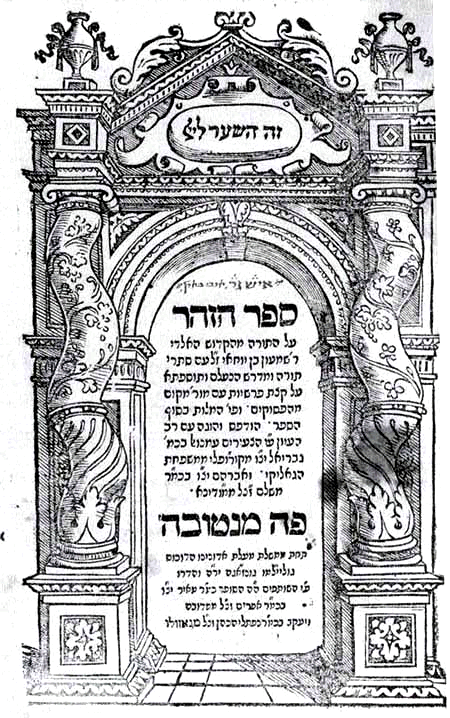

Mosheh de León משה די ליאון
Mosheh ben Shem Tov de León
The Castilian Kabbalist whose composition and circulation of the Zohar in the last decades of the thirteenth century produced the central work of Jewish mystical literature. The pseudonymous attribution to the second-century Tannaitic master Shimon bar Yochai shaped the Zohar's reception for seven centuries before modern philological scholarship established de León's authorship.
Mosheh ben Shem Tov de León (משה די ליאון, c. 1240-1305) is the Castilian Kabbalist whose composition and circulation of the Zohar in the last decades of the thirteenth century produced the central work of Jewish mystical literature. The Zohar’s pseudonymous attribution to the second-century Tannaitic master Shimon bar Yochai — and to the circle of disciples gathered around bar Yochai in the cave of Peki’in where, by the Zohar’s narrative frame, the text was composed in flight from Roman persecution — shaped the work’s reception for seven centuries. Gershom Scholem’s mid-twentieth-century philological work established de León’s authorship of the Zohar in its received form, with substantial engagement of earlier and contemporaneous Castilian Kabbalistic materials. The contemporary scholarly view treats the Zohar as substantially de León’s composition, with Daniel Abrams and others extending the analysis to treat the work as the product of a circle of which de León was the principal figure rather than of de León’s pen alone.
Intellectual biography
Mosheh ben Shem Tov was born around 1240 in León or Guadalajara in Castile, in the period of substantial Jewish intellectual activity that follows the Reconquista’s stabilization of Christian Castilian rule. The principal biographical sources are the testimony of Isaac of Acre (who traveled to Spain in 1305 specifically to investigate the Zohar’s authorship after de León’s death) and the Castilian rabbinic literature contemporary to de León. Isaac of Acre’s report, preserved in fragmentary form, is the key documentary basis for the modern scholarly attribution: de León’s widow, when offered substantial money to produce the supposed ancient manuscript, admitted that there was none — de León had composed the Zohar himself in the persona of bar Yochai.
The intellectual development across his life moves through three principal phases. The early period (c. 1264-1280) is the period of formation, with substantial engagement with Maimonidean philosophical theology (his early Hebrew translations include portions of the Guide of the Perplexed) and with the Geronese Kabbalistic synthesis (Azriel of Gerona, Ezra of Gerona, the early Catalonian school descending from Isaac the Blind). The middle period (c. 1280-1295) is the period of major Zoharic composition, principally in Guadalajara and the surrounding Castilian centers. The late period (c. 1295-1305) sees de León’s Hebrew works composed in his own name (rather than in the bar Yochai persona of the Zohar), including Sefer ha-Rimmon (1287), Mishkan ha-‘Edut (1293), and Sheqel ha-Qodesh (1292). De León died in 1305 in Arévalo, Castile, on his way home from a journey.
The composition history of the Zohar is the central question in de León scholarship. The text circulates principally in fragmentary Aramaic manuscripts during de León’s lifetime; the earliest dated Zoharic citations in independent Kabbalistic literature appear in the 1280s. The integral Zohar as later medieval and early-modern Kabbalah will receive it is largely the product of the post-de León editorial work that organized the fragments and shorter Zoharic units into the synthetic whole subsequent generations would treat as a single book.
Key contributions
The Zohar itself is the central contribution. The work mixes substantial genres: midrashic-narrative engagement with Torah passages, dramatic narrative frame stories of bar Yochai and his disciples (the chavraya, the fellowship), dense mystical-theological exposition in Aramaic prose and verse, and substantial liturgical-mystical material. The work’s central sections — the Sifra di-Tzeniuta (Book of Concealment), the Idra Rabba (Greater Assembly), and the Idra Zuta (Lesser Assembly) — are the most demanding and most consequential. The Zohar establishes the systematic theosophical-Sefirotic articulation that classical Kabbalah will operate within for the subsequent centuries.
The doctrine of the Sefirot as developed in the Zohar transforms the Sefer ha-Bahir’s proto-theosophical articulation into a fully systematic metaphysical-theological structure. The ten Sefirot are organized in three columns (Severity, Mildness, Mercy) and four worlds, with named attributes, gendered and colored, correlated with divine names and parts of the cosmic body. The doctrine of the Shekhinah as the divine feminine — the tenth Sefirah, the divine presence in the world, the partner whose union with the higher Sefirot constitutes the inner life of the divine — is the Zohar’s most distinctive theological innovation and the source of substantial subsequent development.
The literary-narrative method of the Zohar is a distinctive contribution beyond the doctrinal content. Where the Bahir is gnomic and the Geronese Kabbalistic literature is largely systematic-philosophical, the Zohar develops mystical theology through narrative: bar Yochai and his disciples wander the Galilee, encounter passages of Torah, develop the mystical exegesis through dialogue and dramatic incident. The narrative-theological method is inseparable from the doctrinal content; the Zohar’s mystical theology is articulated as much through the relationships among the chavraya and the dramatic frame of the wandering as through the explicit doctrinal exposition.
Key controversies
The authorship question is the central controversy and the principal scholarly issue. Until the modern philological work of Heinrich Graetz in the nineteenth century and Gershom Scholem in the twentieth, the Zohar was treated as a genuinely ancient composition by Shimon bar Yochai and his school. Scholem’s foundational work — particularly Major Trends in Jewish Mysticism (1941) — established the medieval Castilian provenance and de León’s central role on philological-historical grounds: the Zohar’s Aramaic, the philosophical idiom, the engagement with thirteenth-century Castilian Kabbalistic concerns, and the Isaac of Acre testimony together establish the case beyond reasonable doubt. The contemporary scholarly view (Yehuda Liebes, Daniel Abrams, Boaz Huss, others) refines Scholem’s framework but does not depart from the central attribution.
The traditional-Orthodox response to the Scholem attribution is a continuing issue in Jewish religious life. Traditional rabbinic-Kabbalistic communities generally maintain the bar Yochai authorship as a matter of religious commitment, treating the philological evidence as inconclusive or as methodologically inappropriate for sacred-textual analysis. The academic-traditional divide on Zoharic authorship is one of the persistent fault lines between modern critical scholarship and traditional Jewish religious practice.
The circle-versus-individual question is a contemporary scholarly refinement of Scholem’s central attribution. Scholem treated de León as the principal single author. Subsequent work (especially Yehuda Liebes, beginning with his 1989 essay How the Zohar Was Written) treats the Zohar as the product of a circle of Castilian Kabbalists of which de León was the principal but not sole figure. The composition is collaborative-collective in some respects; specific sections of the Zoharic corpus may have substantially different compositional histories. Daniel Abrams has further developed the fragmentary-collection thesis: the Zohar is less a single composed work than a gradually-assembled collection of independently-circulating Zoharic units that medieval and early-modern editorial work consolidated into the integral text.
Transmission received
De León inherits the Bahir-Geronese Kabbalistic synthesis as the principal substrate of his mystical-theological formation. The Sefer ha-Bahir, composed in Provence in the late twelfth century, opens the theosophical articulation of the Sefirot that the Zohar will systematize. The Geronese school (Isaac the Blind, Azriel of Gerona, Ezra of Gerona, the broader Catalonian circle around Nachmanides) develops the Bahir’s apparatus into the systematic-philosophical Kabbalistic register that de León’s contemporaries would inherit.
The Castilian intellectual milieu provides additional formative substrate. Todros ben Joseph Abulafia (1247-1306), Yitzchak ha-Kohen and Jacob ha-Kohen (the Kohen brothers, mid-13th c.), and the broader Castilian Kabbalistic circles develop the demonological-mythological register of Kabbalistic theology that the Zohar will substantially integrate. The Maimonidean philosophical theology provides the negative-philosophical substrate; de León’s early translations of the Guide establish that he operated as a sophisticated reader of Maimonidean negative theology before he turned to the Kabbalistic-narrative register.
Transmission given
The Zohar’s transmission across the next four centuries shapes virtually every subsequent stratum of Jewish mysticism. The Cordoveran synthesis of Moshe Cordovero (1522-1570) in Pardes Rimonim (1548) systematizes the Zoharic corpus into a rationalizing-philosophical framework. The Lurianic synthesis of Isaac Luria (1534-1572) reorganizes the Zoharic material around the doctrines of tzimtzum, shevirat ha-kelim, and tikkun; the Lurianic synthesis becomes the dominant framework within which subsequent traditional Kabbalah operates. The Hasidic recovery of the eighteenth century (the Baal Shem Tov and his successors) inherits the Lurianic-Zoharic synthesis and internalizes it into popular contemplative practice. See the Kabbalah codex for the full institutional context.
The Christian Kabbalah reception runs through the late-fifteenth and sixteenth centuries (Pico, Reuchlin, Knorr von Rosenroth’s 1677-1684 Kabbala Denudata Latin translation of substantial Zoharic portions) and shapes the Renaissance Hermetic synthesis. See the Renaissance Magia codex.
The contemporary scholarly recovery of the Zohar has been led by Gershom Scholem (foundational), Yehuda Liebes (the contemporary Hebrew University school’s principal articulator), Daniel Matt (the multi-volume Pritzker Edition translation, 2003-2017), Daniel Abrams, and Boaz Huss. The Pritzker Edition is the contemporary scholarly translation; the Sperling-Simon Soncino edition (1934) is the principal public-domain translation, partial and dated but accessible.
For the corpus’s institutional and theological context, see the Kabbalah codex. For the lexicon entries on central concepts de León systematized, see Sefirot, Ein Sof, and Sod. For the cross-tradition parallel through the Andalusian milieu, see the map-of-the-interior triangle.
- Sefer ha-Bahir · Sefer ha-Bahir · The Book of Illumination · late 12th century, Provence
Stable URLs are part of the editorial commitment. This address will not change.
Hekhal Editorial. "Mosheh de León." Hekhal: An Open Reference for Esoteric Tradition. Last modified May 2, 2026. https://hekhal.org/figures/mosheh-de-leon.
Hekhal Editorial. 2026. "Mosheh de León." Hekhal: An Open Reference for Esoteric Tradition. https://hekhal.org/figures/mosheh-de-leon.
Hekhal Editorial. "Mosheh de León." Hekhal: An Open Reference for Esoteric Tradition, May 2, 2026, hekhal.org/figures/mosheh-de-leon.
Hekhal Editorial. (2026). Mosheh de León. Hekhal: An Open Reference for Esoteric Tradition. https://hekhal.org/figures/mosheh-de-leon
@misc{hekhal-figures-mosheh-de-leon-2026,
  author       = {{Hekhal Editorial}},
  title        = {{Mosheh de León}},
  year         = {2026},
  publisher    = {{Hekhal: An Open Reference for Esoteric Tradition}},
  url          = {https://hekhal.org/figures/mosheh-de-leon},
  urldate      = {[date accessed]}
}